Posts

Uzbekistan | Nurata

Image
From the Caravanserai of Qarakhanid Khan Shams-al-Mulk Nasr I wandered northward and soon crossed the Zarafshan River. This is of course the river which feeds the Bukhara Oasis; without this river the area would be desert and desert-steppe and the Bukhara conurbation would not exist. The Zarafshan River begins in the Pamir Mountains to the east, in current-day Tajikistan, and flows westward between spurs of the Pamirs known as the Turkestan and Zarafshan ranges before emerging onto the flat plain of Mawarannahr. Its name is derived from the Persian zar afshan , "sprayer of gold", a reference to the gold-bearing sands found in the riverbed of its upper reaches. For thousands of years the river has supported a dense population, the three major cities being Panjikent, in current-day Tajikistan, and Samarkand  and Bukhara in current-day Uzbekistan. The river was once probably a tributary of the Amu Darya, but even by the time of Alexander the Great in the third century BC it was...
Uzbekistan | Caravanserais | Vabkent Minaret | Tavois | Rabat-i-Malik

Image
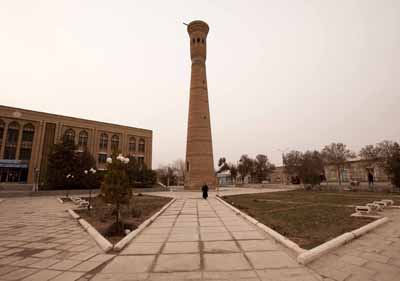
Before indulging in further Ambulations of Bukhara City itself I decided to wander north through the Bukhara conurbation and look for other monuments which pre-dated the Mongol invasion and managed to survive down to the present day. My first stop was Vabkent, seventeen miles north-northeast of Bukhara. When first Chingis Khan and his army approached the Bukhara Oasis they may well have  homed in on Vabkent’s minaret, which was v isible for miles around and served as a beacon for caravans and travelers approaching from the north . Commissioned by Abd al-Aziz II, a member of a powerful Bukhara family during the time of the Qara Khitai Khanate (c. 1125–1218), the 127-foot high minaret, completed in 1198–1199, was the second highest in Mawarannahr, after the Kalon Minaret in Bukhara itself. The Qara Khitai, as you probably know, were a remnant of the old Khitan Dynasty in China—they also Controlled Most of Mongolia At The Time )—who had migrated west and established an empire in In...

Uzbekistan | Bukhara | Kalon Mosque

Image
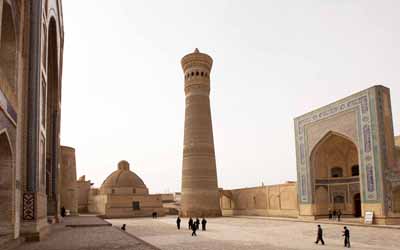
The first big mosque in Bukhara was constructed in 713 within the walls of the Citadel. In 770 a new congregational mosque with accompanying minaret was built outside the Citadel, apparently on the site of the current Kalon Mosque. From the eighth to the eleventh centuries the mosques on this site was repeatedly damaged or destroyed by earthquakes and fires and subsequently rebuilt and enlarged. In 1121-22, during the rule of the Qarakhanids, a still larger mosque and minaret was built on the same location using wood from the previous structure. The minaret soon collapsed, seriously damaged the mosque. In 1127 the mosque was rebuilt yet again, along with the accompanying 153-foot high Kalon Minaret. In the year 1220, on the 10th, or the 16th of  February, depending on whose account we believe,  the hitherto noble city of Bukhara Fell To Chingis Khan and his army. He and his son Tolui rode their horses into the big Friday Mosque on the site of the current Kalon Mosqu...

Uzbekistan | Bukhara | Mir-i-Arab Madrassa

Image
On the other side of the square from the Kalon Minaret and Mosque is the Mir-i-Arab Madrassa, built around 1535. The Shaybanid ruler Ubaydullah Khan reportedly used his share of the money from the sale of 3,000 Persian slaves to finance its construction. The project was carried out by Sayyed M ī r ʿ Abd-All ā h, a Sufi shaikh from the Yemen (some sources say from Sayram in what is now Kazakhstan—take your pick) who arrived to Bukhara around 1515 and became Ubaydullah Khan’s friend and spiritual advisor. The finished madrassa became known as M ī r-i-Arab, another version of Sayyed M ī r ʿ Abd-All ā h’ name.  The madrassa was active from its founding until the 1920s. Only Arabic language was used in the study of theological subjects. Mathematics and the sciences were not encouraged and anyone caught reading secular history, literature, or poetry was immediately shown the door. The madrassa was closed down in 1926 and not reopened until 1946, when Stalin decided to  placate the ...