Posts

Showing posts with the label Mongolia

Mongolia | Aral Sea | Turkey | Istanbul

Image
Threw my Airbook, Kindle, and a camera into a bag and wandered off to Istanbul. I figured I could buy toiletries and whatever extra clothes I needed when I arrived in the city. The Turkish Airlines Boeing 737-900 ER lifted off from Chingis Khan Airport in Ulaanbaatar at exactly 12:49 p.m. The flight was completely sold out. I always enjoy the flight from Ulaanbaatar to Istanbul via Bishkek. The flight path follows much the same route as the old Silk Road and passes over numerous Silk Road cities that I have had the privilege of visiting. On clear days the flier is presented with a fascinating  panorama of the deserts and mountains of Inner Asia.  Unfortunately I would not be seeing much today. We encountered cloud cover just outside of Ulaanbaatar that stayed with us until the approaches to Bishkek.  I was disappointed that I could not see the Tian Shan, to my mind the most noble of all the world’s mountain ranges. Oh, I know that some people rave on about the Himalayas, ...
Mongolia | Ulaanbaatar | Camel Statues

Image
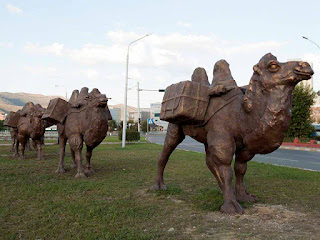
The other day my pal Saka and I went shopping. As we were sitting in a line of traffic backed behind the traffic light at the intersection of Chingis Khan Avenue and the Zaisan Tolgoi road I noticed looming above the tops of cars in front of us a statue of a camel that had recently been installed in a traffic island in middle of the avenue. From our angle only the head of what I thought was one of two camels was visible. “Did you see the statues of the two camels?” I asked Saka. “That’s a great idea. I wonder who is responsible for them?”  “There is only one camel, replied Saka. “No,” I replied, “there are two camels. You just can’t see the other one from here. I hope they install a whole string of them.”  “I just drove by there on my way to your apartment, and there is only one camel there,” she insisted. “There are two,” said I, “do you want to bet on it?  “I don’t bet, but you are wrong; there is only one.”  “No sorry, you are wrong.” The light changed and we drov...

Mongolia | Mongol Empire Era Carpet

Image
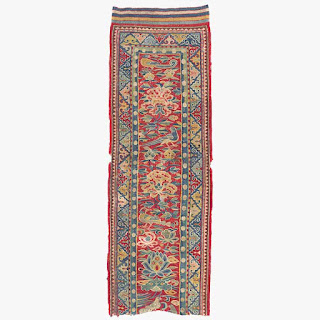
Christies, the big international art auction house, is selling what is “thought to be the sole surviving example of a Mongol Empire carpet.” See  ‘An Extraordinary Survivor’: A Rare Carpet From The Mongol Empire . I would love to have this grace the floor of my hovel in Zaisan Tolgoi , but it is slightly out of my price range (($747,000–$1,045,800 estimate) . It may well be within the range of a certain well-heeled carpet collector in Richmond, Virginia, however. She might want to snap it up while it is still available.  Mongol era carpet; perhaps more properly called a kilim, since it is flat-woven (click on photos for enlargements) Detail of Mongol era carpet

Mongolia | Khövsgöl Aimag | Darkhad Depression #5

Image
We head down the left bank of the Buural Gol through thick taiga to its confluence with the Ulaan Ongo Gol. The source of the Ulaan Ongo, seven or eight miles upstream from here, is only about a mile and a half from the source of the Khoogiin Gol, where we are headed, but Batmönkh says the head of the Ulaan Ongo Gol dead ends in impassable cliffs, making it impossible to reach the Khoogiin Gol from there. Instead we will head farther down the Buural and follow a small tributary of the Buural to a pass leading to the Khoogiin. The trail meanders through thick stands of willows and larch. At places the Buural Gol flows under ten-foot thick-football field-sized slabs of ice which Batmönkh says never melt during the summer. Soon we come to the small unnamed tributary tumbling down a deep ravine to the left. We turn off and follow a vague trail up the right side of the ravine up through a thick larch forest. The misting rain slowly builds into a steady shower. Up ahead, through the mists an...

Mongolia | Khövsgöl Aimag | Darkhad Depression #4

Image
After our late lunch we continue northwest up the valley of the Ikh Cöögt towards 8,550-foot Deed Khets Davaa. The snow-drift lined pass is broad and long, a miniature plateau actually, almost a mile long. Finally we come to an ovoo, seventy feet lower than the highest point of the pass, which overlooks the Buural Gol valley. From here we walk our horses down through a larch forest just over 1300 vertical feet to the banks of the Buural Gol, a major tributary of the Khoogin Gol, whose source is our next desination. The Buural Gol starts about five miles from here, just northwest of Belchir Uul.The Mungaragiin Gol, which we have just come from starts just to the west of Belchir Uul. Another river, the Delger Mörön, starts just south of Belchir Uul and flows southwestward to eventually combine with the Ider to form the Selenge Gol, Lake Baikal’s largest tributary. Thus at the base of Belchir Uul, the nexus of the knot of mountains we are in, begin rivers which flow both into both the Shi...

Mongolia | Khövsgöl Aimag | Darkhad Depression #2

Image
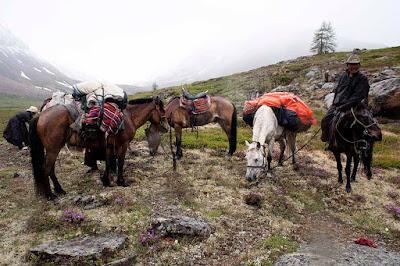
The Wolve s did not reappear last night. Bayarkhüü had come back from the horse herd at sunrise, about 4:30 a.m, grabbed a quick cat nap and was back up at seven. We meet with Batmönkh and him in the ger to discuss our itinerary. I tell him I want to visit two places; the source of the Mungaragiin Gol and the source of the Khoogin Gol but that I really don't care how we get there. I told Batmönkh to pick the route. He allows that he has been to both places several times and he did not anticipate any problems. I had figured that the most direct route to both places and back would cover about seventy miles. Spread out over eight days this would be only 8.8 miles a day, which did not sound too onerous. I told Batmönkh we would take our time and enjoy the country. Loading the two pack horses was facilitated by the three large Kazakh saddle bags of heavy handwoven cloth that I had bought on my last trip to  Xinjiang . At eleven o’clock we bid farewell to the rest of the people at the g...

Mongolia | Khövsgöl Aimag | Darkhad Depression #1

Image
Aftesr visiting the Deer Stones we continued on to the Darkhad Depression. We stopped for lunch at a  guanz  (restaurant in a ger) where the road crosses the Beltes River. There were two other customers in the guanz, each nursing a bowl of milk tea: a woman in her fifties and a man perhaps in his mid-thirties. After some chit-chat the woman got up and left. Our driver whispered, “She is a very famous shaman from the Darkhad Depression. She now lives in Mörön.” I knew that the Darkhad Depression was famous for its shamans. On a previous trip the Darkhad Depression back on 1999 I had noticed that very few Darkhads, the ethic group that inhabits the Depression, had any kind of Buddhist regalia in their gers. Most still believe to one degree or another in traditional Inner Asian-Siberian shamanism. The woman soon reappeared in the guanz. I told her we were going to the Belchir Uul area on the western edge of the Darkhad Depression and asked if she had ever been there. “Many times...

Mongolia | Khövsgöl Aimag | Deer Stones | Graves

Image
Wandered out to Mörön, capital of Khövsgöl Aimag, 575 miles west of Ulaanbaatar ASCF. The plane was supposed to leave at 10:30 am, but due to some unexplained technical problems the flight did not get off until 6:30 pm. The original plan had been to arrive in Mörön at noon, stock up on groceries, and then head north by chartered Russian van into the Darkhat Depression, where we had a horse trip planned. With the late departure we did not arrive until 8:00 pm, after all the stores were closed and it was too late to head out for the day. With the election only two weeks away and all the politicians in town hotel rooms on Mörön were scarcer than in Bethlehem on the first Christmas Eve. The driver of our van allowed us to spend the night in a spare room in his house. The room had no furniture, but nice carpets, so we threw out out sleeping bags and settled in for the night. The next morning we visited various markets and bought potatoes, carrots, cabbage, onions, rice, flour, salt, sugar, ...