Posts

Showing posts with the label Bukhara

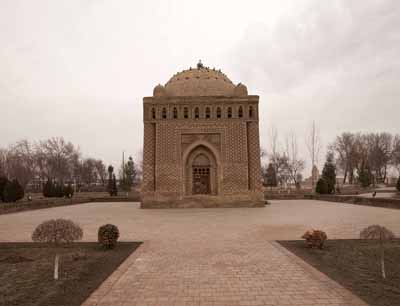
Uzbekistan | Bukhara | Ismael Samani Mausoleum
Image
From Komil’s Guesthouse I wandered over to Ismael Samani’s Mausoleum on the western edge of town ( N39°46'37.10' / E64°24'2.59', three quarters of a mile from the center of town, the center being for our purposes the square between the Kalon Mosque and the Mir-i-Arab Madrassa ). The mausoleum is the oldest building in Bukhara and one of the oldest buildings in Inner Asia. The foundations of the Magok-i-Attari Mosque in Bukhara, originally part of a pre-Islamic Zoroastrian or perhaps even Buddhist temple, may be older, but the original building was destroyed by fire in 937. It was rebuilt in the 12th century, only to be heavily damaged during on the Mongol Assault On The City in the spring of 1220. Apparently only the eleventh-century southern-facing facade has survived intact down to the present day. The Ismael Samani Mausoleum dates from probably the first decade of the the tenth century—it was already completed when Ismael, who consolidated the power of the  Samani...
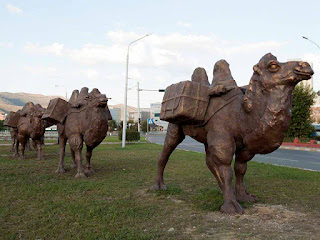
Mongolia | Ulaanbaatar | Camel Statues

Image
The other day my pal Saka and I went shopping. As we were sitting in a line of traffic backed behind the traffic light at the intersection of Chingis Khan Avenue and the Zaisan Tolgoi road I noticed looming above the tops of cars in front of us a statue of a camel that had recently been installed in a traffic island in middle of the avenue. From our angle only the head of what I thought was one of two camels was visible. “Did you see the statues of the two camels?” I asked Saka. “That’s a great idea. I wonder who is responsible for them?”  “There is only one camel, replied Saka. “No,” I replied, “there are two camels. You just can’t see the other one from here. I hope they install a whole string of them.”  “I just drove by there on my way to your apartment, and there is only one camel there,” she insisted. “There are two,” said I, “do you want to bet on it?  “I don’t bet, but you are wrong; there is only one.”  “No sorry, you are wrong.” The light changed and we drov...

Uzbekistan | Bukhara | Kosh Madrassas

Image
The Kosh Madrassas ( kosh = twin, pair, double, etc.) are not identical, but they do face each other across a square. Ubdullah Khan Madrassa, left center, and Modari Madrassa, right center  (click on photos for enlargements) Both were built by  Abdullah Khan II ,  the last  Shaybanid Dynasty  Khan of Bukhara (r. 1583–1598) Abdullah Khan II  The Modari  (mother,  in Persian) Madrassa was built in 1566 in honor of Abdullah Khan’s mother.  Another view of the Modari Madrassa Interior of the Modari Madrassa The   A bdullah Khan Madrassa, facing the Modari Madrassa, was built by  A bdullah Khan in the years 1588-90.  A bdullah Khan Madrassa  Courtyard of  A bdullah Khan Madrassa  Ceiling of A bdullah Khan Madrassa

Uzbekistan | Bukhara | Kalon Mosque

Image
Kalon Mosque, right (click on photos for enlargements), with the facade of Mir-i-Arab Madrassa on the left  Entrance to Kalon Mosque   Entrance to Kalon Mosque  Courtyard of Kalon Mosque   Courtyard of Kalon Mosque Interior gallery of Kalon Mosque

Iran | Yazd | Carpets

Image
While in Yazd I wandered by a complex of shops selling pottery, brass and copper work, fabrics, clothes, carpets, and other items of interest to tourists, gadabouts, and pilgrims, both domestic and international.  Courtyard of the shopping complex (click on photos for enlargements) Pottery for sale at the complex I was most interested in carpets. Stepping into one store I was surprised to see a selection of carpets very much like some that I already had in my hovel in Zaisan Tolgoi . I had bought mine in Bukhara, Uzbekistan, however. “Where are these carpets made?” I asked. I fully expected the salesmen to say “Yazd”, since most visitors are interested in buying locally made products. Instead he answered, “They are made in Serakhs.” “Serakhs, Iran, or Serakhs, Turkmenistan?” I wondered. The salesmen smiled, “Probably both.” Salesmen in carpet store I have of course been in Serakhs, Turkmenistan, since it was one of the cities trashed by Chingis Khan’s son Tolui in 1221. I did not ...

Mongolia | Uzbekistan | Chingis Khan Rides West | Chapter 5

Image
Wrapping up  Chingis Khan Rides West . See sample chapter:  The March from Otrar and the Fall of Bukhara

Uzbekistan | Bukhara | Bakharzi | Bayan Quli | Sorqaqtani

Image
Update: I just got an email from an informant in Ulaanbaatar telling me that there is now a best-selling book in Mongolia (in Mongolian language) about the life of Sorqaqtani. Wandered out to the Fathabad district, about two miles east of the old historical core of Bukhara, to visit the mausoleum of Saif ed-Din al-Bakharzi. The mausoleum complex is now in a nicely laid out park surrounded by four-lane highways and Soviet-era apartments blocks. Bakharzi was born in Khorasan (now northeastern Iran) and studied religion in Nishapur and Herat before moving to Gurganj (now Konye Urgench in Turkmenistan). Gurganj was the capital of Khwarezm, the land on either side of the lower Amu Darya River, including the broad delta estuary of the river on the southern edge of the Aral Sea. By the beginning of the thirteenth century Khwarezm had become the core province of the Khwarezmian Empire, which under the leadership of Muhammad Khwarezmshah (r. 1200-1220) included a huge swatch of Asia from th...