Posts

Showing posts with the label Khoresm

Uzbekistan | Khorezm | Khiva | al-Khwārizmī
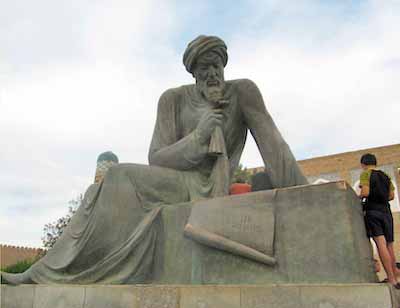
Image
After viewing the Summer Mosque in Khiva I wandered outside the city walls and soon found myself in front of the statue of Abū ʿAbdallāh Muḥammad ibn Mūsā al-Khwārizmī (c. 780–c. 859). Sources vary on the birthplace of al-Khwārizmī, but at least one historian, Ibn al-Nadim, asserts that he was born in Khorezm (also known as Khwarizm), and local boosters insist that despite all the various nay-sayers he was born right here in Khiva, hence his statute here on the main drag in front of the city walls.  Al-Khwārizmī  was a celebrated geographer, astronomer and mathematician and is acknowledged as the inventor of  Algebra , a dubious accomplishment which has earned him the well-deserved opprobrium of generations of high school students the world over. Statue of Abū ʿAbdallāh Muḥammad ibn Mūsā al-Khwārizmī (c. 780–c. 859) Al-Khwarizmi's most famous (or perhaps most notorious) book, in which he formulated the basis principles of algebra, was entitled  Hisab ...
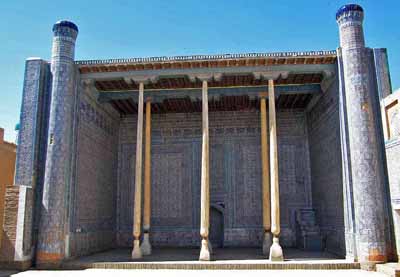
Uzbekistan | Khorezm | Khiva | Kunya Ark and Summer Mosque

Image
After visiting the Harem of Allah Kuli Khan I wandered by the Summer Mosque of the Kunya Ark, or Citadel. Finished in 1838, the mosque features spectacular tilework by local masters Ibadullah and Adullah Jin, who had also worked on Allah Kuli Khan’s harem.  Summer Mosque Pillars in the Summer Mosque Base of pillar in the Summer Mosque Pillars and Tilework  Tilework Tilework Tilework Tilework Minbar, or pulpit, in the corner of the mosque  The Kunya Ark, or Citadel, from outside View of the Inner City from the top of the Citadel View the Inner City from the top of the Citadel View from the top of the Citadel, with the Kalta Minaret , top, left-center View from the top of the Citadel with Islam Hoja Minaret (1910), middle Heart-palpitatingly gorgeous local hand-woven carpet. I sat on it for an hour, soaking up the vibes, but in the end did not buy, since the next stop in my wanderings is  Bukhara , whose very name is synonymous with carpets.   Thi...

Uzbekistan | Khorezm | Khiva | Harem of Allah Kuli Khan

Image
While I was mainly interested in Remnants of Khiva Pre-Dating the Mongol Invasion  I thought that while I was in town it would be downright churlish not to wander by the Harem of Allah Kuli Khan (r. 1825–42), even though it is a relatively recent structure, dating back to the 1830s. The Harem is part of the so-called Tash Hauli Palace, which many of you are no doubt familiar with from the descriptions given in Frederick Burnaby’s A Ride to Khiva: Travels and Adventures in Central Asia  (1876) and  The Life and Adventures of Arminius Vambery, Written by Himself  (1883) Both Burnaby and Vambery visited the palace after the death of Allah Kuli Khan, however, and of course neither of them gained access to the Harem. Allah Kuli Khan’s seventeen-year reign as Khan of Khiva began in 1825 with the death of his father Muhammad Rakhim Khan. In 1830 he decided to built a new palace on the eastern side of the city. He envisioned a sprawling complex with 163 rooms and three...

Uzbekistan | Khorezm | Khiva | Djuma Mosque

Image
After wandering about the Fifty Forts Region along the northern bank of the Amu Darya I returned to Khiva . I was most interested in finding what traces if any of Khiva survived the Mongol invasion of the lower Amu Darya in the winter of 1220-1221.  Although much has been written about the fall of Urgench, further on down the Amu Darya (now known as Kunye Urgench, or Old Urgench, now in Turkmenistan, and not be to confused with New Urgench, in Uzbekistan just east of Khiva), none of the contemporary Persian accounts of the Mongol invasion that I am aware of say anything about Khiva. Ala'iddin Ata-Malik Juvayni (1226–1283), for instance, in his book Genghis Khan: The History of the World Conqueror , gives a harrowingly detailed account of the fall of Urgench, but as far as I can tell, given the confusion over name places, he makes no mention of any Mongol attack on Khiva. Yet Khiva was a prominent city in the thirteenth-century and would have been a tempting target for plunde...

Uzbekistan | Khorezm | Nukus | Fifty Forts Region

Image
From Khiva I wandered on down the Amu Darya River (also known as the Oxus)  to the city of Nukus. Actually I did not want to go to Nukus. I was much more interesting in the ruins of the old Silk Road cities and fortresses scattered along the north bank of the Amu Darya, but my driver insisted that all tourists  who come this way go to Nukus to visit the  Karakalpakstan State Museum of Art . Unfortunately he did not point out why all tourists go to the Karakalpakstan State Museum. It turns out, according to A Recent Story In The New York Times , t hat this “museum in the parched hinterland of Uzbekistan . . . is home to one of the world’s largest collections of Russian avant-garde art.” I did not know this at the time. I did peek through a few doorways into galleries containing what looked like avant-garde art, but of course I did not go in, since I have not the slightest interest in anything avant-garde and indeed little interest in any art created s...