Posts

Showing posts with the label Enrico Dandolo

Italy | Venice | Full Moon | Rialto News

Image
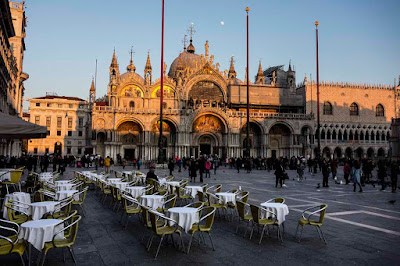
As soon as the Blizzard in Istanbul subsided I wandered off to Venice. I had four goals in mind:     See the Full Moon of January 12 over St. Marks Square     Check the news on the Rialto     Continue the Investigations into the life of Enrico Dandolo that I began on my last trip to Venice.  View the loot stolen by Enrico Dandolo and the his Venetian cohorts during the Sack of Constantinople (Istanbul) in 1204  The Full Moon, partially obscured by clouds, over St. Mark’s Square (click on photos for enlargements).  Another view of the Full Moon over St. Mark’s Square  The Rialto Bridge across the Grand Canal. The current version of the 104-foot long stone bridge was built between 1588 andl 1591. Actually there wasn’t much news on the Rialto. If I hear of anything I will let you know.  View from the Rialto Bridge Grand Canal from the Rialto Bridge

Italy | Venice | Enrico Dandolo #6

Image
By the 1070s both the Byzantine Empire and the Venetian Republic were threatened by the rapacious Normans from western Europe. The Normans were descendants of pirates, freebooters, and marauders from Iceland, Denmark, and the western Scandinavian Peninsula who by the tenth century had settled in the part of northern France that now bears their name—Normandy. Ambitious, foot-loose, and militaristic, they quickly moved east and by 1017 had established footholds in southern Italy. They soon controlled most of the southern half  of the Italian Peninsula and by 1072 had seized Sicily. Their leader Robert de Hauteville, known better known as Robert Guiscard (“the Crafty”) then set his sights on the Golden Apple, Constantinople, the ultimate prize of a long string of marauders dating back to Alaric the Goth and Attila the Hun. His plan was to proceed from the Norman strongholds on the boot heel of Italy across the Strait of Otranto to the coastline of the Balkans and seize the city of Dur...

Italy | Venice | Enrico Dandolo #5

Image
Despite of the claims of  Joseph Farrell , the Dandolos do not appear to have been descended from Mesopotamian slaves. Later, when they were one of the most prominent families in Venice, the Dandolos would promote the notion that their ancestors were among the leaders of the the refugees who had fled the depredations of the Goths and the Huns in the fifth century and that thus they were one of the founding families of Venice. This was a common claim among the families of Venice who wanted to assert that they did indeed belong to the aristocracy, much like Americans who place great stock in the claim that their ancestors come to the New World on the Mayflower and landed at Plymouth Rock. According to the legend favored by the Dandolos themselves, they were prominent citizens of Padua before moving to the islands in the Venetian Lagoon, where they took their rightful place among the Rialto elite. The truth is less clear. There is no mention of them at all in the earliest histories of...

Italy | Venice | Enrico Dandolo #4

Image
According to tradition, the city of Venus was founded at the stroke of noon on Friday, March 25, a. d. 421. On the Catholic calendar it was the Feast of the Annunciation, celebrating the day when the angel Gabriel announced to the Virgin Mary that she would be the mother of Jesus Christ, the Son of God. The story goes that around this time three Roman consuls from the city of Padua on the mainland came to a group of islands two miles from the coast known as  the Rivoalto ,  or “high bank”. On slighter higher ground on both sides of a deep channel running through the area settlers from the mainland had established a small community. The area where they settled became known as the Rialto, a corruption of rivoalto , and adjacent channel was eventually transmogrified into the Grand Canal. The three consuls had supposedly come to the Rialto to set up a trading post and found a church dedicated to St. Giacomo (James), thus sanctioning the small settlement.  A church of St. Giac...

Italy | Venice | Enrico Dandalo #3

Image
To the west Campo Santa Maria del Giglio opens unto a smaller square known as Campiello Feltrina. From here Calle Zaguri crosses a canal known Rio de S. M. Zobenigo.  The bridge over the canal, the Ponte de la Feltrina, is one of 435 bridges in Venice (including the island of Guidecca, south of the six districts name earlier) that cross the city’s 182 named canals. It is also considered to be of the more picturesque. I know this because I hear a tour group leader pointing it out to her ten or so charges. On the other side of the bridge is a Chinese tour group of some fifteen people led by a women carrying a long stick topped by a yellow flag that she frantically waves to assemble her wandering troops. Young Chinese women on the bridge itself pose in varying degrees of allure for photos while others jockey for positions from which to take selfies. Attracted to this site by the tourists are four beggars, two on each end of the bridge. Two are decrepit old men, obviously locals, with...

Italy | Venice | Enrico Dandolo #2

Image
The  Hotel Casanova  where I am staying is located on Frezzeria Street, named after the arrow ( frecce ) shops with which it was once lined. Arrows were an important commodity in fourteenth century Venice, when all adult males were expected to be proficient in the use of the crossbow. Arrows have gone the way of Zip discs; now the street hosts hotels, restaurants, and up-scale clothing stores geared toward tourists. The legendary swordsman and memoirist Giacomo Casanova (1725–1798) once lived just off Frezzeria Street, in the Corte del Luganegher; no doubt the hotel got it name from this association. The English gadabout, poet, and prime-time cad Lord Byron (1788–1824) found lodging just up the street from my hotel at building number 1673 when he first arrived in Venice in 1816, and he very quickly managed to seduce his landlord’s wife, the delectable twenty-two year old Marianna, who according to Byron was “in her appearance altogether like an antelope.” Presumably this was m...

Italy | Venice | Enrico Dandolo #1

Image
After my Visit To the Tomb of Enrico Dandolo in Istanbul I wandered further west to Venice. I wanted to see his birthplace and the four copper statues of horses that he had expropriated from Constantinople after the sack of the city in 1204. The flight from Istanbul to Venice takes two hours and twenty-five minutes, landing at Marco Polo (what else?) Airport at 12:50 p.m. local time. A paved pathway leads several hundred yards from the airport exits to the water buses that transport arrivals two miles across the lagoon to Venice. Although I have read John Julius Norwich’s magisterial  A History Of Venice (who hasn’t?) and several other books about Venice and its role at the ultimate western terminus of the Silk Road I was woefully ignorant about the details of actually visiting the city. All I knew I had gleaned from the internet the night before in my hotel room in Istanbul and in the Turkish Air business lounge at Ataturk Airport. The water bus made seven stops before arriving ...

Turkey | Istanbul | Hagia Sophia | Enrico Dandolo

Image
From the Obelisk of Theodosius I wandered east through Sultanahmet Square, soon passing by the the Kaiser Wilhelm Fountain, an octagonal domed structure built by the German government in 1900 to mark the German Emperor Wilhelm II's visit to Istanbul in 1898. Near here would have stood the starting gates used for horse and chariot races in the old Byzantine Hippodrome which occupied the area now taken up by Sultanahmet Square.  Mounted above the starting gates were larger-than-life size copper statues of four horses. Their provenance is unclear (an Entire Book has been written on this issue and the horses in general) but they were probably made in what is now Greece and used to ornament some monumental structure there. Greece having been subsumed by the Byzantines, Theodosius II, the same Theodosius who built the Land Walls , expropriated the horses and had them moved to Constantinople, where they were used to ornament the Hippodrome. When the Crusaders and Venetians sacked...