Posts

Showing posts with the label Khwarezm

Uzbekistan | Khwarezm | Janpiq Qala

Image
From Gyaur Qala we drove southeastward 4.5 miles to Janpiq Qala. Built in the ninth or tenth century a.d. during an economic boom in Khwarezm, it was situated on the site of an older fortress dating back to the period between the fourth and first centuries b.c. The walled city, measuring 1500 feet long and up to a thousand feet wide, developed into a substantial craft center with quarters devoted to weaving, stone carving, blacksmithing, and the manufacture of glass and pottery. It was also an important trade entrepôt on the Amu Darya where goods from China, India, Egypt, and the Volga River and Black Sea regions all washed up. Russian researchers have suggested that a large breach in the southern wall was made by the besieging Mongols when they attacked Khwarezm in the winter of 1220-1221, perhaps with a huge battering ram. How much other damage the city suffered at the hands of the Mongols is unclear, but the city did recover and it eventually regained much of its former prominence...
Mongolia | Chingis Rides West | Emissaries and Trade Caravans

Having already received an Embassy from the Khwarezmshah and met with Traders from the Khwarezm Empire , Chingis decided to respond in kind by sending his own emissaries to the Sultan’s realm. He took a two-pronged approach. A diplomatic mission would make contact with the Khwarezmshah himself in hopes of establishing the peaceful relations necessary for further trade, and an officially sanctioned trading mission would demonstrate to the Khwarezmshah and his subjects just how how lucrative trading with Mongols could be. The three merchants who had just visited Chingis would accompany the Mongol-sponsored caravan of traders back to Khwarezm and presumably act as intermediaries. According to one account, the embassy was dispatched before the trading mission left for Khwarezm. Another maintains that the embassy left at the same time as the trading mission but then at some point en route hurried on ahead for a meeting with the Khwarezmshah himself.  The leaders of the diplomatic embas...

Mongolia | Chingis Rides West | Chingis Khan and the Khwarezmshah

One ruler who could not help but take note of Chingis Khan’s sudden rise to power in the East was Ala ad-Din Muhammad II, the Sultan of the Khwarezm Empire, also known as the Khwarezmshah. The empire over which he reigned was by 1215 the most powerful state in Central Asia. Centered around the ancient province on Khwarezm on the lower valley of Amu Darya River—the Oxus of Antiquity—and the delta of the river where it flowed into the Aral Sea, the Khwarezmshah’s domains extended westward to the edge of the Iranian Plateau and south to the Persian Gulf, encompassing much of current-day Iran. HIs territories abutted Mesopotamia, home of the long-ruling ((750-1258) Abassid Caliphate whose ruler an-Nasir was the Caliph—the Commander of the Faithful—of the Muslim world. The Khwarezmshah had even launched an attack on the Abbasid Dynasty in an attempt to overthrow the Caliph an-Nasir and name one of his own nobles as “Commander of the Faithful”, thus making himself Islam’s most powerful figur...

Uzbekistan | Khorezm | Khiva | al-Khwārizmī

Image
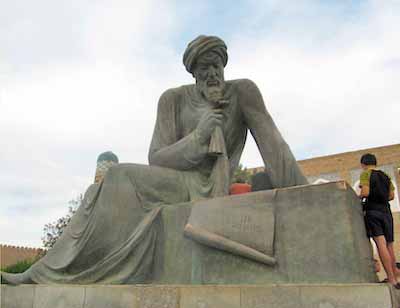
After viewing the Summer Mosque in Khiva I wandered outside the city walls and soon found myself in front of the statue of Abū ʿAbdallāh Muḥammad ibn Mūsā al-Khwārizmī (c. 780–c. 859). Sources vary on the birthplace of al-Khwārizmī, but at least one historian, Ibn al-Nadim, asserts that he was born in Khorezm (also known as Khwarizm), and local boosters insist that despite all the various nay-sayers he was born right here in Khiva, hence his statute here on the main drag in front of the city walls.  Al-Khwārizmī  was a celebrated geographer, astronomer and mathematician and is acknowledged as the inventor of  Algebra , a dubious accomplishment which has earned him the well-deserved opprobrium of generations of high school students the world over. Statue of Abū ʿAbdallāh Muḥammad ibn Mūsā al-Khwārizmī (c. 780–c. 859) Al-Khwarizmi's most famous (or perhaps most notorious) book, in which he formulated the basis principles of algebra, was entitled  Hisab ...

Uzbekistan | Khorezm | Khiva | Kunya Ark and Summer Mosque

Image
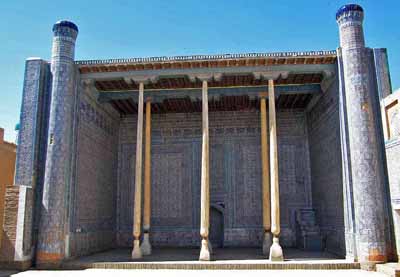
After visiting the Harem of Allah Kuli Khan I wandered by the Summer Mosque of the Kunya Ark, or Citadel. Finished in 1838, the mosque features spectacular tilework by local masters Ibadullah and Adullah Jin, who had also worked on Allah Kuli Khan’s harem.  Summer Mosque Pillars in the Summer Mosque Base of pillar in the Summer Mosque Pillars and Tilework  Tilework Tilework Tilework Tilework Minbar, or pulpit, in the corner of the mosque  The Kunya Ark, or Citadel, from outside View of the Inner City from the top of the Citadel View the Inner City from the top of the Citadel View from the top of the Citadel, with the Kalta Minaret , top, left-center View from the top of the Citadel with Islam Hoja Minaret (1910), middle Heart-palpitatingly gorgeous local hand-woven carpet. I sat on it for an hour, soaking up the vibes, but in the end did not buy, since the next stop in my wanderings is  Bukhara , whose very name is synonymous with carpets.   Thi...

Uzbekistan | Khorezm | Khiva | Harem of Allah Kuli Khan

Image
While I was mainly interested in Remnants of Khiva Pre-Dating the Mongol Invasion  I thought that while I was in town it would be downright churlish not to wander by the Harem of Allah Kuli Khan (r. 1825–42), even though it is a relatively recent structure, dating back to the 1830s. The Harem is part of the so-called Tash Hauli Palace, which many of you are no doubt familiar with from the descriptions given in Frederick Burnaby’s A Ride to Khiva: Travels and Adventures in Central Asia  (1876) and  The Life and Adventures of Arminius Vambery, Written by Himself  (1883) Both Burnaby and Vambery visited the palace after the death of Allah Kuli Khan, however, and of course neither of them gained access to the Harem. Allah Kuli Khan’s seventeen-year reign as Khan of Khiva began in 1825 with the death of his father Muhammad Rakhim Khan. In 1830 he decided to built a new palace on the eastern side of the city. He envisioned a sprawling complex with 163 rooms and three...