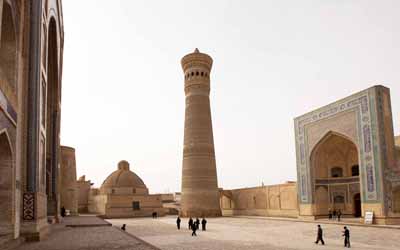
I already mentioned that only two structures in Bukhara survived the invasion of the city by Chingis Khan in 1220: the Ismael Samani Mausoleum and the Kalon Minaret. The later is located right in the very heart of city, in a large plaza between the Kalon Mosque, the largest mosque in Bukhara, and the Mir-Arab-Madrassah. The current structure is 153 feet high, making it visible, some say, for as far as eight miles from the city. Chingis Khan, approaching from the north, no doubt had the Kalon Minaret in sight as he zeroed in on the city. A Friday Mosque has stood on the sight of the current Kalon Mosque since at least the tenth century. The first Kalon minaret was built to accompany this mosque in 919, during the time of the Samanids, but it was destroyed by “an act of God”, perhaps an earthquake, in 1068. A wooden minaret was built to replace it by the Arslan Khan of the Qarakhanids, who ruled Bukhara at the time, but this structure later collapsed, reportedly killing many...