Posts

Iran | Sultaniyya | Mausoleum of Ilkhan Ölziit

Image
Wandered by the town of Sultaniyya, site of the mausoleum of Öljeitü (Ölziit in Mongolian), the eighth Ilkhan. Ölziit was the great-grandson Khülegü Khan, founder of the Ilkhanate, and the great-great-great-grandson of Chingis Khan . It was Ölziit (r. 1305–1316) who had moved the capital of the Ilkhanate from Tabriz to Sultaniyya, 175 miles to the southeast. At the insistence of his mother Uruk Khatun, a Nestorian Christian, he had been baptized as a Christian and given the name Nicholas. When he was still in his teens, however, he married a Muslim girl, and apparently under her influence he converted to Islam. At first he was a Sunni Muslim, but he eventually became disillusioned by Nit-Picking Sunni Jurists and switched to Shiism. Perhaps to burnish his credentials as a Shiite he hatched a scheme to move the bodies of the two proto-martyrs of Shiism, Ali, the son-in-law of the Prophet Muhammad, and Ali’s son Husain, from their shrines in Iraq to Sultaniyya and hou...
Iran | Esfahan | Abbasi Hotel

Image
Wandered down to Esfahan , south of Tehran. I was especially looking forward to visiting Esfahan since I had booked a room at the legendary Abassi Hotel, which if not the city’s best hotel is certainly the most historic and picturesque. Location of Esfahan  (click on photos for enlargements). The Abbasi Hotel was originally a caravanserai built during the time the the Safavid Sultan Husayn (1668—1726). It was restored and remodeled in the 1950s into an upscale hotel. Film buffs may recognize the hotel as the set for the 1974 movie Ten Little Indians starring Oliver Reed and German bombshell Elke Sommer. I had read some on-line reviews that groused about the small size of some of the rooms at the hotel. This was certainly not the case with my first floor room, which opened directly onto the courtyard. A troop of dancers, had one been available, could have bivouacked in the room with space left over for a camel or two.  This etching was made in 1840.  The basic layout of t...

Italy | Venice | St. Mark’s Basilica | Four Horses

Image
Of all the treasures looted by Doge Enrico Dandolo and the Venetians during the sack of Constantinople in 1204 perhaps the most famous are the four horses now on display in St. Mark’s Basilica Museum in Venice. Where these horses were originally made and by whom is a matter of great scholarly debate. I intend to investigate this matter in due course. For the moment suffice it to say that they eventually ended up on top of one of the gates of the immense stadium in Constantinople known as the Hippodrome . After being seized by the Venetians in 1204 they stood for centuries on the facade of St. Mark’s Basilica. When Napoleon Bonaparte seized Venice in 1797 he had them carted off the Paris, a fittingly prize for what he considered to be the new center of world civilization. After the Little General met his Waterloo they were returned to Venice and placed back on the facade of St. Mark’s. Air pollution from industries on the mainland, however, wrecked havoc on the copper statues. In the 1...

Cyprus | Paphos | Moon | Aphrodite

Image
Carnival begins in Venice on Jan. 27 but people start celebrating early. When I saw the first people in masks in Campo St. Bartholomew I hurried back to my hotel room and booked the next flight to Athens via Istanbul. Took the 7:32 am water bus to the airport the next morning. The Visa Flap with Turkey is over. All they did was raise the prices. Before an electronic visa was $20; now they are $70. I had a five hour layover in Istanbul so I took the Metro downtown to change money. The exchange rates in Venice are nothing short of larcenous. On Divan Yolu in Istanbul there are at least a dozen currency exchanges all competing against one another. Asking at half a dozen places the best offer I got for $1000 was 810 Euros. This was very close to the official exchange rate on the internet. The best offer I had in Venice was 750 Euros for $1000. And in Venice you have to present your passport and fill out a form which even asks for your address in the States. Like I have an address in the...

Croatia | Istrian Peninsula | Pula

Image
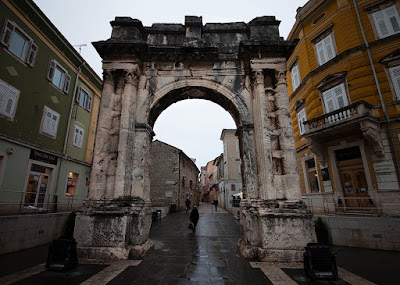
From Venice   I wandered on down to Pula in Croatia. Old Roman-era portal leading to the old town of Pula (click on photos for enlargements) Statue of James Joyce outside a cafe he frequented when he lived in Pula Square in the old town of Pula, which is a pedestrians-only area. It was early morning so there was no one about. Temple of Augustus, built by Emperor Augustus (r. 27 BC–AD 14), said to be the oldest Roman monument in Croatia. On the right is a Neo-Pagan tree offering. The most famous Roman monument in Pula is the Amphitheater built in the first century a.d. by Roman Emperor Vespasian (r. 69–79). The amphitheater seated about 20,000. Gladiators fought each other here (whether they fought to the finish is unclear), and also fought wild beasts like lions and tigers, whose cages can still be seen. Nowadays we have only the NFL. But James Harrison would have made a great gladiator! By the fifth century the teachings of the Nazarene, a temple to whom can be seen in the b...