Posts

Greece | Old Corinth

Image
Wandered over to Corinth, forty-five miles east of Athens but slightly longer by train. Corinth is located on the west side of the 3.5 mile wide isthmus that separates the Peloponnese Peninsula from the Attica region around Athens and the rest of Greece.  (Click on images for enlargements) My main interest is visiting the site of the old Temple of Aphrodite, located on the top of 1876-foot peak of Acrocorinth, just east of the town of Old Corinth. There is a metro to the Larissa Train Station, which serves trains running to the north, and from here you have to take a train another fifteen minutes or so to a another station that handles trains running south to the Peloponnese.  The trip to Corinth takes about an hour. From the Corinth train station I took a taxi to Old Corinth, the village located near the archeological park that hosts the ruins of ancient Corinth. The modern city of Corinth, to the west of the station, is a relatively modern reiteration of an older city destro...

Greece | Athens | Mouseion Hill | Hill of the Muses

Image
Wandered up 485-foot Mouseion Hill for a panoramic view of the Acropolis. The hill got its name from the 6th-century BC poet and seer Musaios , who was supposedly buried on its summit. Because of its association with Musaios, reputed to be the son of the legendary minstrel Orpheus , it is also known as the Hill of the Muses. Part way up I passed by the Prison of Socrates, where, according to legend, the great philosopher was confined before he was forced to the drink the Hemlock.  Prison of Socrates (click on photos for enlargements) Socrates was an enigmatic character, to say the least. He was born not far from Athens in 469 B.C., the son of stonemason who aspired to be a sculptor. His mother was a midwife. Socrates too may have worked for awhile as a stonemason before finding his true calling as a free-lance philosopher and teacher. With thick lips, bulging eyes, and a pot-belly, he was a notoriously unattractive figure. He seldom bathed or washed his clothes and went barefooted ...

Greece | Athens | Areopagus | Apostle Paul

Image
From the Summit Of The Acropolis I descended the slope through the Beulé Gate, built into a wall around the Acropolis apparently dating to the 280s B.C. This is the way most visitors access the Acropolis. I had entered via the less used Southern Gate. The Beulé Gate (click on photos for enlargements) Just below here a low saddle leads west to a 377-foot hill known as the Areopagus. In very ancient times a council of nobles used to meet here to discuss affairs of state. Courts also held sessions here. In the 480s B.C., after the rise of democracy the nobles began to meet elsewhere, but murder and treason trials were held here for several more centuries. As I was climbing to the top of Areopagus I caught the distinctive smell of marijuana smoke. Arriving at the top, I encountered three Greek teenagers smoking a spliff which would have made Snoop Dogg proud. The Areopagus is perhaps best known as the site where the Apostle Paul, he of Road to Damascus fame, gave one of his famous sermons...

Greece | Athens | Acropolis | Parthenon

Image
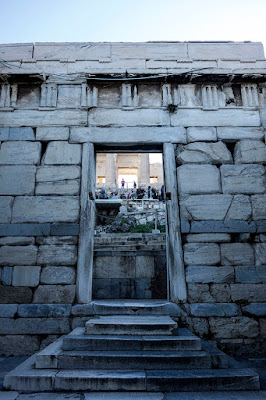
I have been through the Athens airport eight or ten times but had never gone downtown. Deciding that it was time to finally see the birthplace of Occidental civilization I booked a room literally in the shadow of the Acropolis, the huge hill in the middle of the city topped by the Parthenon. Unfortunately I picked a bad day to arrive. The train service from the airport to downtown was on strike and I was forced to take a taxi, which immediately set me back 38 Euros plus 2 for the freeway toll.  Welcome to Greece. This was quite a bit more than my hotel room. At least the taxis were working, When I visited the Greek Island of Crete a year earlier all public transport was on strike and I was forced to hitchhike from the airport to town. Fortunately I was picked up was a charming young woman and her two friends who went out of their way to drop my off right in front of my hotel and also gave me an informative introduction to Crete.  My hotel, with a balcony view of the Acropolis...

Italy | Venice | We Crociferi

Image
I had intended to stay in Venice only three days, but once I was there I thought, what the heck, I am here, why rush off? I soon discovered, however, that the guesthouse where I was staying was all booked up and I could not keep my room any longer. Actually, after three days I was already tired of the place. It was located on an extremely quiet five-foot wide passageway, but this passageway opened out onto a busy shopping street lined with very upscale brand-name stores and white-tablecloth restaurants. There were no grocery stores or bakeries in the area and even the stand-at-the-counter coffee shops seemed expensive compared to other neighborhoods. While searching booking.com for new accommodations I noticed a place called We Crociferi in the Cannaregio district of Venice. The photo showed a huge white building in front on a long, narrow square. I realized I had walked by this building many times without realizing what it was. Apparently the building was an old monastery...

Cyprus | Paphos | St. Paul’s Pillar

Image
After an enlightening few days at We Crociferi in Venice I wandered on to Athens, Crete ,  and Rhodes , before finally washing up in Larnaca, Cyprus .  Cyprus (click on iamges for enlargements)   Statue of my man Xeno in Larnaca After spending a day Getting Back In Touch With My Inner Stoic —as you probably know, Larnaca (then Kition) was the birthplace of the Greek philosopher Zeno ( c.352 BC–c.255 BC) , founder of Stoicism—I moved on to Paphos , at the western end of Cyprus Island. According to legend Aphrodite was born just up the coast from Paphos and I was eager to see her birthplace, but first I wandered by the church of Panagia Chrysopolitissa to see St. Paul’s Pillar. Alleged route of Paul and Barnabas through Cyprus. This assumes they used roads built by the Romans to get from Salamis to Paphos. Their itinerary is not detailed in the Bible.  Paul—he of Road To Damascus fame—and his sidekick Barnabas arrived on Cyprus in  45 or 46 AD, landing ...

Italy | Venice | St. Mark’s Basilica

Image
The morning after the Full Moon I wandered by St. Mark’s Square again.  Venice, with St. Mark’s Square in center, near the eastern end of the Grand Canal, which snakes its way through the big island (click on photos for enlargement) St. Mark’s Square, with the basilica of St. Mark to the right. The big U-shaped building below the basilica is the Doge‘s Palace. St. Mark’ Square, with the Basilica of St. Mark and the 323-foot high Campanile, or Bell Tower, at the far end. Snow had fallen the night before and was still a stiff damp wind whipping around the plaza.Thus the place was pretty much deserted. Another view of  St. Mark’ Square  A 1503 etching of St. Mark’s. Not much has changed.  St. Mark’s Basicila The first version of St. Mark’s was completed in 832. It had been built to house the relics of St. Mark, which had been stolen and spirited out of Alexandria, Egypt, in 828 by Venetian traders. This church burned in 976 and was later rebuilt. Not much is known a...