Posts

Uzbekistan | Bukhara | Magok-i Attari

Image
Bukhara claims to be one of the world’s oldest cities. In 1997 the city celebrated its 2500th anniversary, although admittedly this date seems to have been chosen somewhat arbitrarily. According to archeological findings, the earliest levels of settlement in Bukhara date from somewhere between the fifth and second centuries b.c. A “large, sprawling settlement” and earliest manifestation of the Ark (Citadel) appear somewhere in this time frame.  Whether they existed by the time  Alexander The Great And The Greeks Swept Through The Region   is unclear. An ark did soon appear however (apparently on roughly the same spot as the current-day Citadel). and by the third century b.c. it had been re-enforced with walls over twenty feet thick. The current-day Ark is a much later structure, but it supposedly stands on the same site as the ancient arks of 2300 or so years ago. (Click on photos for Enlargements)  At this time the Bukhara Oasis was part of the Bactrian Kin...

Mongolia | Chingis Khan’s Tomb | Burkhan Khaldun

Image
Once again the search for the tomb of Chingis Khan is heating up. It is now the subject of a Cover Story in Newsweek Magazine . As the story points out, this has been going on for decades now. I must admit I do not share the fascination many people have about Chingis’s tomb. It is clear from the record that Chingis Khan did not want people to know where he was buried. We should leave it at that. Of course, many assume that he must have been buried with a huge amount of treasure which would have an immense historical—to say nothing of monetary—value, but I am not sure that any historical evidence that such treasure exists.  As a bibliomane, I am much more interesting in what happened to the original Mongolian version of the Secret History of the Mongols , the fundamental text of Mongolian history, which is in large part an account of Chingis’s life.  The original book in Mongolian, most of which probably written in 1228, was supposedly taken to China, where a phonetic version o...

Mongolia | Russia | Buryatia | Mayan–Shambhala Endgame

Image
In a post back in September about the Blue Moon I wrote: “Fasten your seat belts, people! It is going to be a Wild Ride to the  Winter Solstice on December 21 , when all Hell is expected to break loose . . . ”  Well, things are already heating up in Russia, according to this Story in the New York Times :  There are scattered reports of unusual behavior from across Russia’s nine time zones. Inmates in a women’s prison near the Chinese border are said to have experienced a “collective mass psychosis” so intense that their wardens summoned a priest to calm them. In a factory town east of Moscow, panicked citizens stripped shelves of matches, kerosene, sugar and candles. A huge Mayan-style archway is being built — out of ice — on Karl Marx Street in Chelyabinsk in the south. For those not schooled in New Age prophecy, there are rumors the world will end on Dec. 21, 2012, when a 5,125-year cycle known as the Long Count in the Mayan calendar supposedly comes to...

Uzbekistan | Bukhara | The Poet Rudagi

Image
When I woke up unexpectedly at three a.m. last night it suddenly dawned on me that I have not said nearly enough about the Samanids, who ruled Bukhara from c.875 to 999 a.d. Bukhara, under Samanid rule, was the Focus of Splendour, the Shrine of Empire, the Meeting-Place of the most unique intellects of the age, the Horizon of the literary stars of the World, and the Fair of the great scholars of the Period. So intoned historian Abu Mansur Abdu l-Malik ath-Thaalibi (961–1038), who as a young man was privileged to sit at the feet of the savants of Bukhara. One literary star of the time was Rudagi (858–c.941), who was born in a village near Samarkand   on the middle Zerafshan River (some say a village near Panjakant, in current-day Tajikistan).  According to some accounts, he was blind from birth or early childhood, although this has been disputed. He flowered early as a poet and as a lyricist who may have sung his effusions and accompanied himself on the harp. He was soon notice...

Uzbekistan | Bukhara | Lyab-i-Haus

Image
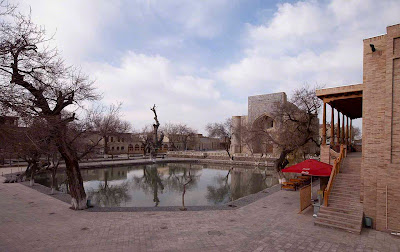
Arguably the social center of modern Bukhara is the Lyab-i-Haus Complex, named after the haus , or reservoir in its middle. In summer the reservoir is lined with tables served by nearby restaurants and the square itself is thronged with local idlers of all persuasions, sight-seers, tourists, and Turkish adventuresses. In late winter the square around the reservoir is pretty much deserted.  Lyab-i-Haus Complex, looking west (Click on photos for Enlargements) On the north side of the square is a two-story restaurant and to the right, across a street, is the Kukeldash Madrassa. T he south side of the square is lined with stores and  Hotels . The Kukeldash Madrassa, which now faces the Lyabi-Haus Complex, pre-dates the complex itself. It was built in 1568-1589 at the time of Shaibanid ruler Abdullah Khan, during whose reign Trade Dome #1 , Trade Dome #2,   the Abdullah Khan Tim ,  and probably Trade Dome #3 were also constructed. Commissioned by Abdullah Khan’...

Mongolia | Gov-Altai Aimag | Gobi Bears | Mazaalai

Image
According to Recent Findings there are now only twenty-two Gobi Bears—or  Mazaalai as they are called in Mongolian—left in the world. This is down from a reported thirty-three a few years ago. This must make them one of the rarest species in the world. I have had my own run-ins with  Mazaalai over the years .  The first time I visited Shar Khuls Oasis on the border between Gov-Altai and Bayankhongor aimags we could not camp in the oasis itself because our camels refused to stay there—way too much fresh bear scat around. We had to camp a few hundred yards out in the desert.  A couple years later I returned to Shar Khuls Oasis while on my way the Hideout of the Notorious Ja Lama . A few miles south of Shar Khuls we were actually Charged By A Gobi Bear . Thus my companions and I are probably some of the few people to see one of these bears close-up in a natural setting (most researchers see them from blinds). I was too busy getting my camel out of the way of the ch...

Chingis Khan Rides West | March from Bukhara to Sarmarkand

Image
By the beginning of March Chingis Khan was ready to march on Samarkand. The two Jewels of Mawarannahr, Bukhara and Samarkand, were linked by the so-called Royal Road, an ancient thoroughfare following roughly the course of the Zarafshan River. Samarkand is 135 miles east of Bukhara as the crow flies, but upstream from Bukhara the Zarafshan River loops to the north before continuing on east, and the distance between the two cites via the Royal Road, which roughly follows the river, was between thirty-seven and thirty-nine farsakhs (148 to 156 miles) Zarafshan Valley from Bukhara to Samarkand (see Enlargement )  This was a journey was six or seven stages, or days, by camel. Accompanied by the huge flock of levies who had been dragooned in Bukhara for the anticipated siege of Samarkand, the Mongol army proceed north on the Royal Road, probably passing once again through the towns of Shargh, Iskijkath, and Vabkent   and finally reaching the edge of the Bukhara Oasis at Tawais . . ...