Posts

Uzbekistan | Bukhara | Abdullah Khan Tim | Carpets

Image
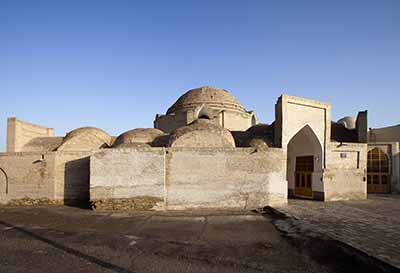
I left the northern entrance to Tok-i-Tilpak Furushon and proceeded along Shah Restan Street 430 feet to the entrance of the Abdullah Khan Tim on the right. While a trading bazaar with several entrances, like  Trade Dome #1 and Trade Dome #2 , are called tok , a trade arcade with only one entrance is known as a tim . At one time there were at least six tim on this street, plus numerous other bazaars and caravanserais. The Abdullah Khan Tim, the only one now remaining, was built in 1577 by the Shaybinid Abdullah Khan . Once it was one of Bukhara’s most upscale trading venues, specializing in high-quality silk and wool goods. At least fifty small trading booths, many manned by Afghani traders, lined the interior. The center of the tim now serves as a spacious carpet store. Shah Restan Street, with the entrance to the  Abdullah Khan Tim right of center and the  Tok-i-Tilpak Furushon (Trade Dome #2) just visible at the end of the street. Entrance to  Abdullah Khan Tim...
Uzbekistan | Bukhara | Trade Dome #2

Image
Backtracking a bit along the Shah Rud Canal from the Khodja Mosque and Gaukushan Madrassa Complex and then turning left and proceeding 510 feet along a row of old caravanserais I soon come to Trade Dome Number Two, or the Tok-i-Tilpak Furushon. This is the old Cap-Maker’s Bazaar where karakul and fur hats and embroidered skull caps were previously sold. The bazaar also served as a bookstore, with more or than twenty stalls selling rare and unusual books and manuscripts. This trade dome differs from the other two in having five portals instead of four leading to the large enclosed center. Tok-i-Tilpak Furushon Interior of  Tok-i-Tilpak Furushon In one corner of the interior is a niche holding the tomb of local holy man Ahmad I Paran. The tomb is currently overseen by an old graybeard who collects donations from local people passing through the bazaar. It is not clear if he has any official capacity or has just taken over the area on his own. With his enormous nose and traditional ...

Uzbekistan | Bukhara | Nogai Caravanserai | Gaukushan Madrassa | Khodja Mosque

Image
Just south of the Tok-i-Saffaron , along the Shah Rud Canal, is the Nogai Caravanserai, built in the 1720s during the reign of the Shaybinids. This modest-sized caravanserai has a pleasant stone paved, tree-strewn courtyard surrounded by forty-five-odd room which once served as temporary quarters for traveling merchants  and caravan men. The rooms now serves as shops selling miniatures, puppets, and the usual array of silk and wool goods, including suzanis and wall-hangings.  Shah Rud Canal in the foreqround; Nogai Caravanserai on the other side. Front of Nogai Caravanserai Nogai Caravanserai Courtyard ( Enlargement   for ames) A few hundred yards down the Shah Rud Canal is the Khodja Mosque and Gaukushan Madrassa Complex. “Gaukushan” reportedly means “one who kills bulls”; in the early sixteenth century there was a slaughter-house on the site. In the years 1562–1566 a madrassa was built here; it soon became known as the Gaukushan Madrassa. In 1598 Juibar Sheikh Khodja Ka...

Uzbekistan | Bukhara | Trade Dome #1

Image
After returning from My Sojourn to Nurata I continued my peregrinations of  Bukhara .  I pretty much had the city to myself. From March 1 to March 12 I was the only guest in the Guesthouse Where I Was Staying , and as far I could tell I was the only Occidental tourist in the whole town. There were of course other tourists and pilgrims in Bukhara, but the vast majority of these seemed to be from other areas of Uzbekistan and from neighboring Kazakhstan and Tajikistan, with a smattering from other countries of the Asian-Islamic geosphere. The men from these all of these places were obvious from the fact that almost 100% of them wore black leather coats and jackets. I had chosen to come to Bukhara in the off-season (as far as Occidental tourists were concerned) both to avoid the sweltering heat I had experienced during a Previous Trip to Bukhara in June and to take advantage of the cheaper off-season rates at the hotels. Having spent the winter in Ulaanbaatar, where the tempera...

Mongolia | Zaisan Tolgoi | Blue Moon

Last night, August 31, the Full Moon occurred at exactly 10:58 pm. It was also a Blue Moon. As noted below, I went into Occultation on September 2 , the date of the previous Full Moon. I always go into Complete Occultation for the entire lunar cycle leading up to a Blue Moon. I am not at liberty to tell you how or where I spent my Occultation. The reasons for occultation are occult, so I cannot explain them here, but a little research on the internet will reveal the details to those you who are interested. Anyhow, today, September 1, the morning after the Blue Moon, I am coming out of Occultation. I am  also back on the internet (it is amazing what has happened in the world since I last checked the news:  Snooki Had a Baby  and   Anal Tattooing Is the Next Big Thing ). I must note, however, that this was a Blue Moon only by what might be called the Folkloric Definition ,  or, as Sky and Telescope Magazine calls it, the  Trendy Definition . This is when two...

Occultation

Don Croner is in Occultation.

Mongolia | Töv Aimag | Erdene Uul | Burkhan Khaldun | Summer Solstice

Image
The Summer Solstice , marking the longest day of the year, occurred here at 7:09 a.m. on Wednesday, June 21. For many years I have gone to the Summit of Bogd Khan Uul , one of the Four Sacred Mountains surrounding Ulaanbaatar, to celebrate the Summer Solstice. This year I decided to observe the Solstice by visiting Erdene Uul (mountain) in Töv Aimag, 92 miles east of Ulaanbaatar as the crow flies. Erdene Uul, overlooking the valley of the Kherlen River, is also known as Burkhan Khaldun. It is one of three Burkhan Khalduns identified by researchers D. Bazargür and D. Enkhbayar: Erdene Uul, the Burkhan Khaldun of the Uriangkhai; Khentii Khan Uul, the Burkhan Khaldun of the Khamag Mongols ; and Asralt Khairkhan ,   the Burkhan Khaldun of the Keraits. Khentii Khan Uul is of course the most  famous of the Burkhan Khalduns; this is the one where most people go on pilgrimages and to where the President of Mongolia is required to go once every four years.  Erdene Uul, howev...

Mongolia | Turkey | Istanbul | Sultanahmet

Image
I awoke at my regular time and after the usual orisons settled into the southeast nook of my Studiolum for morning tea. Just the day before I had received a shipment of this Spring’s harvest of Imperial Mojiang Golden Bud Yunnan Black Tea and was looking forward to trying it again. All went well as I sipped the first two bowls. The tea was fresh and young, all knees and elbows, sassy without being impertinent. Notes of chocolate, tobacco, malt, and, if I am not mistaken, a hint of pachouli flared up and then drifted away. During my third bowl, however, my tea drinking revelry was interrupted by a somber note of unease which had insidiously crept into my mind stream. By the time I finished the bowl I was overtaken by a fissiparous existential crisis which finally congealed into one simple question: “What the heck am I doing here?” Why was I sitting on this carpet, in this apartment in Zaisan Tolgoi, a suburb of Ulaanbaatar, Mongolia? What concatenation of circumstances ha...

Uzbekistan | Nurata

Image
From the Caravanserai of Qarakhanid Khan Shams-al-Mulk Nasr I wandered northward and soon crossed the Zarafshan River. This is of course the river which feeds the Bukhara Oasis; without this river the area would be desert and desert-steppe and the Bukhara conurbation would not exist. The Zarafshan River begins in the Pamir Mountains to the east, in current-day Tajikistan, and flows westward between spurs of the Pamirs known as the Turkestan and Zarafshan ranges before emerging onto the flat plain of Mawarannahr. Its name is derived from the Persian zar afshan , "sprayer of gold", a reference to the gold-bearing sands found in the riverbed of its upper reaches. For thousands of years the river has supported a dense population, the three major cities being Panjikent, in current-day Tajikistan, and Samarkand  and Bukhara in current-day Uzbekistan. The river was once probably a tributary of the Amu Darya, but even by the time of Alexander the Great in the third century BC it was...