Posts

Uzbekistan | Bukhara | Chasma Ayub

Image
Seven hundred feet northeast of Ismael Samani’s Mausoleum is the Spring of Job, he of Afflictions notoriety. According to legend, way back in Old Testament days, long before Jesus was even a gleam in Joseph’s eye (assuming you do not believe in the doctrine of the Immaculate Conception) Job was wandering around in Mawarannahr, the land north of the Amu Darya River. As if he did not have enough problems of his own, here in the valley of the Zerafshan River, where Bukhara is now located, he encountered a terrible drought. A famine raged and people were dying of thirst. Job in his rage at these conditions thrust his walking stick into the ground and amazingly enough sweet, cool water began to pour out of the hole he had made. This water source began known as the Spring of Job, or Chasma Ayub.  In the 12th century the Qarakhanid chieftain Arslan Khan, who then ruled Bukhara and as we shall soon see also built the famous Kalon Minaret, built a monument around the spring (which in fact ...

Uzbekistan | Tashkent | Bukhara

Image
Woke up this morning in Bukhara, Uzbekistan. I am not quite sure how I got here. I seem to recall a hurried trip to the airport in Ulaanbaatar; a three hour flight to Seoul, an overnight in a luxurious hotel near the airport, courtesy of Korean Airlines, since I was flying with KAL to Tashkent, the capital of Uzbekistan, the next day; a seven hour and twenty minute flight from Seoul to Tashkent; a night in the Grand Wazoo Hotel in Tashkent; a quick trip in the pre-dawn darkness to the domestic airport in Tashkent, a fifty minute flight to Bukhara; and taxi ride to Komil’s Guesthouse in the southern part of the Old City, where I soon found myself in the ornately decorated dining room having breakfast. Welcoming sign at Komil’s  Entrance to Komil’s Guesthouse    Interior of guesthouse. The building was once the private residence of a prosperous Bukharan trader.  Dining Room in the guesthouse Wall furnishings in the dining room Wall furnishings in the dining room

Mongolia | Incarnations of Javsandamba 16 – 25

Image
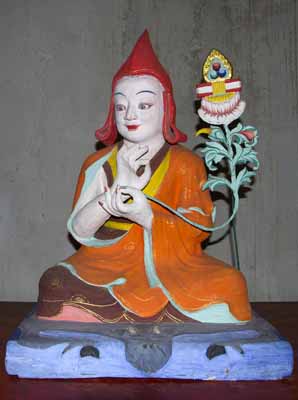
Earlier I posted about the statues of  the first    First Sixteen Incarnations of Javzandamba  on display in the Larivan Temple at Erdene Zuu, in Kharkhorin, Övörkhangai Aimag. The sixteenth incarnation was of course  Taranatha , who was born in Tibet and died in Mongolia.  16. Жонан Дарната Jonan Darnata (Taranatha) statue at Erdene Zuu Tibetan thangka of Taranatha This spectacular late nineteenth century thangka of Yamantaka (it measures over seven feet in length) was just recently unearthed in the archives of the Bogd Khaan Winter Palace Museum , a vast repository of materials many of which have never been put on public display before or even catalogued. The first twenty-four incarnations of Javzandamba are depicted at the top of the thangka.  Taranatha on the Yamantaka thangka above The next nine incarnations (17 through 25) served as the Bogd Gegeens of Mongolia. The first was of course Zanabazar .  17. 1 Богд Занабазар (1635-1723) Zanabaza...

Mongolia | Fifth of the Nine-Nines | Tavisan Budaa Khöldökhgui

Image
The Fifth of the Nine-Nines—nine periods of nine days each, each period marked by some description of winter weather—began on January 27. This is Tavisan Budaa Khöldökhgui , the time when “Cooked Rice Cannot Be Frozen.” I must admit I really don’t understand the definition of this period. It seems to me that cooked rice would be frozen at any temperature below freezing, and we can certainly expect colder temperatures than that during the last week of January and beginning of February. Anyhow, the Fourth of the Nine-Nines was supposed to be coldest of the Nine-Nines, but this year the Fifth might well turn out to be colder. I have blogged in the past about the Magical Moment when 40 below zero are the same on the Fahreinheit and Celsius scales. The last few days we have been having a Magic Moment every morning. This morning it dropped down to a frosty 45 below 0º F. Some old Gray Beards I spoke with at the Bogd Khaan Winter Palace Museum yesterday assured me that this wo...

Mongolia | Fourth of the Nine Nines | Dönön Ükhiin Ever Khöldöne

Update : 40º below 0 F. at 8:00 am on Thursday the 19th and calling for 47º below 0º F. tonight. So the Fourth of the Nine-Nines is living up to its reputation as the coldest of the nine nine-day periods of winter weather. The Fourth of the Nine-Nines, known as  Dönön Ükhiin Ever Khöldöne —Time When Four Year-Old Cows’ Horns Freeze—begins today, January 18. This is supposed to be the coldest of the Nine-Nines, nine periods of nine days each, each period marked by some description of winter weather. It was 20 below F. (–29º C. for you unrepentant Celsius freaks) at 10:00 am, not especially cold for  This Time Of The Year . But the forecast for this week is for much, much colder weather, maybe even record-setting. Stay tuned . . . 

Chingis Khan Rides West | Flight of the Khorezmshah | Nishapur | Ray | Hamadan

As we have seen, the Khorezmshah spent almost a month Carousing with the Songstresses and Damels of Nishapur. These bacchanalias ended when word arrived that the Mongol pursuit party which had been sent to bring the Khorezmshah to heel was on the way.  The Mongol commanders Jebe and Sübetei and their 30,000 men arrived at the walls of Nishapur in early June, after the Khorezmshah had already fled.  They immediately sent an envoy into the city to met with local officials and demand food and other supplies. Three local envoys then came out to met Jebe and proffer gifts and provisions. They made an outward show of submission, but Jebe was not satisfied.  He harangued them about the futility of any further resistance and to reenforce his point he presented to the town fathers a copy of a decree in Uighur script from Chingis Khan, apparently stamped with his own seal,  which stated: Whosover . . . shall submit, mercy will be shown to them and unto his wives and children ...

Mongolia | Third of the Nine Nines | Gurvan Ükhrii Ever Khöldönö

The Third of The Nine-Nines began on January 9, which was also a monumental Full Moon Day.  Gurvan Ükhrii Ever Khöldönö  is the nine-day period of Winter when the horns of three year-old cows freeze. This period is supposed to be colder than the  First of the Nine Nines  and the  Second of the Nine Nines .  At 7:30 this morning it was 26 below 0º F, about normal for this time of the year.  Tsagaan Sar , the Mongolian Lunar New Year, is coming up with the New Moon on February 22. The coming year is, of course, the Year of the Male Water Dragon, which is the 26th year of the 17th Rabjung, or 60-Year Cycle, according to the Tibeto-Mongolian Calendar. 

Mongolia | Second of the Nine Nines | Khorz Arkhi Khöldönö | Sogdians

Image
I mentioned earlier that the First of the Nine-Nines —the Nine-Nines being nine periods of nine days each, each period characterized by a certain type of winter weather—started on the day of the Winter Solstice , which occurred here in Mongolia on December 22. The Second of the Nine Nines began yesterday, December 31. Known as Khorz Arkhi Khöldönö , this is the time when twice-distilled homemade Mongolian arkhi (vodka) freezes. As you will recall, the first of the Nine-Nines was the time when regular, or once distilled, arkhi freezes. As this indicates, the second period should be colder than the first, since twice distilled arkhi obviously has a much higher alcohol content. This morning at 6:30, however, it was a balmy 1º above 0 F. (-17º C.) Expect colder weather by the end of the week.  As some of you may know, today is also the first day of the year according to the admittedly outdated and outmoded Gregorian calendar which unfortunately seems to hold much of the world in its...

Mongolia | Winter Solstice | Ist Nine-Nine | Nermel Arkhi Khöldönö

Image
Well, it is that time of the year again! Get that  Elk Antler Headdress out of the attic and shake the dust off your tambourines! The Winter Solstice occurs today at 1:30 p.m. (Ulaanbaatar Time), marking the beginning of Winter. See  Winter Solstice 2010 at Stonehenge , the granddaddy of all Solstice celebration sites. Here in Zaisan Tolgoi the sun rises at 8:39 and sets at 5:02 for a day of 8 hours, 22 minutes, and 54 seconds, the shortest day of the year of course. Tomorrow the day will be two seconds longer, which means we have turned the corner and are on the way to the Spring Equinox on March 20, 2012. My house plants have been slumping, and I can only hope that they will sense the turn of the seasons and perk up, since moping house plants are a little more than I can deal with right now. In Mongolia the Winter Solstice also marks the beginning of the so-called Nine-Nines: nine periods of nine days each, each period marked by some description of winter weather...

Mongolia | Töv Aimag | Aryaval Khiid

Image
Bayantsagaan Wandered by the crib of  Bayantsagaan , head of Lam Rim Khiid near Gandan. He had called and asked me to stop and discuss a book he was writing. He does not speak much English and of course my Mongolian is limited, but we usually manage to get by without a translator. Indeed, we had no problem discussing the publishing project he had in mind. But then he started talking about Aryaval Khiid, another temple in Terelj National Park north of Ulaanbaatar which he himself had founded. He could not seem to get his point across, so he got out his mobile phone, a new smart phone the brand of which I did not notice (I am not a mobile phone freak) and made a video-call to his daughter in the United States. Holding the phone in front of us, we had her translate while we watched her on the screen. So, I thought, this is the world we live in; we are sitting in Mongolia and making a video call to the United States to have someone translate for us. His daughter,  Erdenetse...