Posts

Mongolia | Chingis Rides West | Fine Fabrics

In the account of the Three Merchants from Khwarezm it is perhaps significant that only fabrics were mentioned. The Mongols were in need of much else from sedentary societies, including metals for weapons, tools, and utensils, pottery, and grains, but these utilitarian items were seldom discussed. The foremost among trade items, or at least those which attracted the most interest, were silks, satins, damasks, brocades, and other fine textiles. There is no doubt that Mongols loved luxurious fabrics. As shown by the incident in which Chingis showed the three Khwarezm merchants a warehouse stuffed with expensive textiles, the Mongol upper-crust was by 1215 already well-supplied with these expensive trade items. Clothes made from luxurious fabrics were status symbols, and on ceremonial occasions Mongol leaders liked to drape themselves in gold brocades that “would gladden the heart of a Liberace,” as historian of textiles within the Mongol Empire Thomas Allsen puts it.  The Mongols’...

Syria | Damascus | Gay Girl Blogger | Last Update

Image
Very Last Update, later on 06/13/11: Now the NYT has weighted in with what will hopefully be the Last Word on this ultimately sordid tale. I did not realize that the blogger had been taken so seriously in various political circles. These people now feel duped and betrayed. Oddly enough, it was his defense of Sunni Muslim Beliefs   that seemed most genuine . . . Wow! People are piling on now! See Screw You, Tom MacMaster . Latest Update 06/13/11: Five days ago I wondered if the Gay Girl Blogger from Damascus could possibly be a guy. Now it turns out there is a “bizarre twist” to the story! The blogger is a guy! See Apology To Readers . Why did the thought cross my mind that the blogger might actually be a guy? Somehow the story seemed just a little too neat . . . Anyhow the author, Tom MacMaster, might be able to make a career out of writing soft-porn lesbian poetry . . . and Sunni manifestos!  And he was posting, so he claimed, from Istanbul , of al...

Mongolia | Chingis Rides West | Three Muslim Traders

Since at least the second century B.C. the people known as Sogdians , inhabitants of the oasis cities of Transoxiania, the land between the Amu Darya and Syr Darya rivers, had been trading with China far off to the east. Sogdian merchants around this time were familiar with Chang’an (the Current City Of Xian ), which would later became perhaps the most important eastern terminus of the Silk Road, and they also initiated trade with the Xiongnu (Hunni) peoples of current-day Mongolia. According to Chinese sources,  At birth honey was put in their mouth [so they would be adept at the sweet talk often needed to seal a deal] and gum was put on their hands [so that any money they touched would stick to them] . . . they learned the trade from the age of five . . . and at twelve were sent to do business in a neighboring state. To the west they eventually extend their trade networks into Iran and across Asia Minor to Constantinople , capital of the Byzantine Empire.  Such was their bu...

Mongolia | Chingis Rides West | Chingis Khan and the Khwarezmshah

One ruler who could not help but take note of Chingis Khan’s sudden rise to power in the East was Ala ad-Din Muhammad II, the Sultan of the Khwarezm Empire, also known as the Khwarezmshah. The empire over which he reigned was by 1215 the most powerful state in Central Asia. Centered around the ancient province on Khwarezm on the lower valley of Amu Darya River—the Oxus of Antiquity—and the delta of the river where it flowed into the Aral Sea, the Khwarezmshah’s domains extended westward to the edge of the Iranian Plateau and south to the Persian Gulf, encompassing much of current-day Iran. HIs territories abutted Mesopotamia, home of the long-ruling ((750-1258) Abassid Caliphate whose ruler an-Nasir was the Caliph—the Commander of the Faithful—of the Muslim world. The Khwarezmshah had even launched an attack on the Abbasid Dynasty in an attempt to overthrow the Caliph an-Nasir and name one of his own nobles as “Commander of the Faithful”, thus making himself Islam’s most powerful figur...

Mongolia | Chingis Rides West | Jurchens | Jin Dynasty | Part IV

The Mongols would not have long to enjoy their plunder. In July of 1214, when they were fattening their horses on the steppe, came the disturbing news that Emperor Xuanzong had abandoned Zhongdu, the Northern Capital. On 30,000 carts, and accompanied by 3000 camel loads of treasure, the Jin court and government had left Zhongdu and was on its way to the Southern Capital (current-day Kaifeng), hopefully out of reach of further Mongol incursions. Many Jurchens viewed this apparent refusal to face the Mongol threat head-on as abject cowardice on their part of their leadership. Mutinies broke about among Jurchen troops and even more units defected to the Mongols. The Southern Sung Dynasty, sensing the impotence of the Jin, refused to cough up the tribute it had previously promised to pay them. Chingis Khan, after the humiliating terms he had early imposed on the Jin, considered them to be subordinate to the Mongols, indeed part of the nascent Mongol Empire, and he viewed the move south as ...

China | iPad | Kidneys

Did you hear the one about the Chinese kid who sold his kidney so he could buy an iPad 2?  This Is Not A Joke .  Speaking of iPads, I was sitting in a Louche Coffee Shop  (I do occasionally go slumming) in Ulaanbaatar the other day  and someone said to me, “Oh, an iPad! Is that an iPad 2? What a ridiculous question! Do I look like someone who would be using an obsolete Mac product?

Mongolia | Chingis Rides West | Jurchens | Jin Dynasty | Part III

The invasion began in May of 1211. This was no small move on Chingis’s part. The Jin Dynasty, despite the symptoms of dynastic decay which had been reported to Chingis by his various spies, was still one of the five or six great sedentary states of Eurasia. The Jin state had a population of perhaps 40,000,000, although only around 3,000,000 of the populace were Jurchens, descendants of the original Jurchen tribesmen from Manchuria, the rest being Han Chinese and other indigenous peoples. The Jin state could muster 150,000 or so cavalrymen, most of the Jurchens, and 300,000 to 400,000 infantrymen, most of them Chinese. The loyalty of these Chinese infantry was, of course, in question. Still, according to one modern historian, “the Jin army retained a reputation as the most powerful military state in the known world.”  Chingis had under his overall commanded one army of perhaps 50,000 cavalry led by himself, and another army of 50,000 cavalrymen led by three of his sons. His ranks wo...

Mongolia | Chingis Rides West | Jurchens | Jin Dynasty | Part II

During Chingis Khan’s rise to power he had sought of patronage of Tooril, the powerful ruler of the Kerait Tribe who was headquartered in the valley of the Tuul River not far from current-day Ulaanbaatar. Tooril had recognized the nominal suzerainty of the Jin and apparently paid tribute to to them. In return he was awarded the title of Wang (or Ong) Khan. As one of Tooril’s vassals Temûchin also received a minor title from Jin Dynasty and may have also paid tribute. There are also hints that Temüchin sought refuge among the Jurchen during the low points in his early career when he was being hounded by more powerful Mongol tribes.  Chingis Khan and the Wang Khan would later fall out and the Keraits would be defeated, calling into question the Jin title Temüchin had received as one of the Kerait ruler’s vassals. The Jin, for their part, still believed that Chingis Khan owed loyalty and tribute to them, even after he had been confirmed as leader of all the Mongols at the 1206 convo...

Mongolia | Zaisan | Gaga Invasion

Image
Yesterday was Children’s Day in Mongolia. I went downtown to get my mail (the kind lady at my branch post office now sends me a text message when I get mail) and noticed block parties for children, complete with balloons and loud music, everywhere. Then I returned to Zaisan. It turns out the apartment complex next to my hovel was having a big party in its courtyard, complete with hundreds, maybe thousands, of balloons (what’s with the balloon thing?), clowns in uniform, and a sound system that boomed music loud enough to be heard a half mile away. The music was—you know it’s coming—Lady Gaga’s latest album “ Born This Way ”. It was on endless loop and played for at least three hours. Perhaps nine out of ten people listening do not understand English and thus do not know what she is singing about, but who cares? It is just a wall of sound. Now I am as big a  Lady Gaga Fan  as the next guy, but this was just too much. I tried to settle down with the book I had jus...

Mongolia | Chingis Rides West | Jurchens | Jin Dynasty | Part I

Earlier I wrote about the Uighurs and the Xi Xia . Now I must finally turn my attention to the Jin Dynasty, also known as the Jurchen Dynasty (1115–1234). The people known as Jurchens who went on to found the Jurchen, or Jin Dynasty, originated around the timbered basins of the Amur, Ussuri, and Sungari rivers in Manchuria, in what is now northeast China. Their language was Tungusic, an eastern extension of the Altaic language family and closely related to Manchu, the language of the people what would later create the Qing Dynasty.  Almost nothing is known of their history prior to the tenth century a.d. Apparently they began to use iron only in the early eleventh century. One tribe of the Jurchen, the Wanyan, began making farming tools and weapons from iron and on the basis of this new technology soon dominated their neighbors. Under the leadership of a chieftain known as Wugunai (1021–1074) the Wanyan soon assumed leadership of a loose confederation of the various Jurchen ...

Mongolia | Töv Aimag | Baga Nuur | Zevgee’s Family

Image
Wandered on out to Baga Nuur to visit the family of my friend Zevgee , who recently transmigrated. My last visit to Baga Nuur, to celebrate Women’s Day , was a happier occasion. Saraa , Zevgee’s wife Tümen-Ölzii, Zevgee and Enkha  celebrating Women’s Day This time Zevgee was no longer with us, but I did have the opportunity of meeting up once again with his family members, many of them from Bayankhongor Aimag, where Zevgee was born.   Five of Zevgee’s brothers, to the right, in Baga Nuur A few years ago I did a camel trip from Amarbuyant Khiid in Bayankhongor to Shar Khuls Oasis with Zevgee, his wife, and two of his brothers, Davakhüü and Khaidav, following the Route Of The 13th Dalai Lama and The Roerich Expedition .    Davakhüü  Khaidav Khaidav, Zevgee’s son Bira, his brother-in-law Shoovoi, and Davakhüü loading a camel at Amarbuyant Khiid  Davakhüü and Khaidav with four of their magnificent camels at Amarbuyant Khiid  Zevgee, Khaidav, ...

Uzbekistan | Khorezm | Khiva | al-Khwārizmī

Image
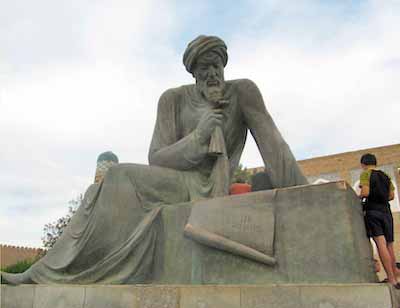
After viewing the Summer Mosque in Khiva I wandered outside the city walls and soon found myself in front of the statue of Abū ʿAbdallāh Muḥammad ibn Mūsā al-Khwārizmī (c. 780–c. 859). Sources vary on the birthplace of al-Khwārizmī, but at least one historian, Ibn al-Nadim, asserts that he was born in Khorezm (also known as Khwarizm), and local boosters insist that despite all the various nay-sayers he was born right here in Khiva, hence his statute here on the main drag in front of the city walls.  Al-Khwārizmī  was a celebrated geographer, astronomer and mathematician and is acknowledged as the inventor of  Algebra , a dubious accomplishment which has earned him the well-deserved opprobrium of generations of high school students the world over. Statue of Abū ʿAbdallāh Muḥammad ibn Mūsā al-Khwārizmī (c. 780–c. 859) Al-Khwarizmi's most famous (or perhaps most notorious) book, in which he formulated the basis principles of algebra, was entitled  Hisab ...

Mongolia | Töv Aimag | Zevgee — 1938–2011

Image
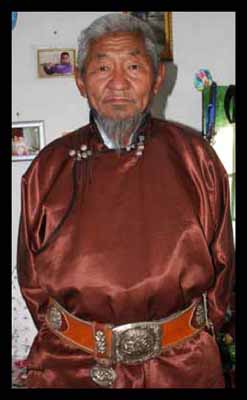
Zevgee (1938–2011) My good friend Zevgee transmigrated on the Full Moon Day of May 17, which by coincidence (or maybe not) was the day of  Vesak , the Buddhist holiday observing the Buddha's Birth, Enlightenment, and Death, and also, according to Some Interpretations , the anniversary of the day the Buddha first taught the Kalachakra Tantra. I first met Zevgee in 1997, as described in Part Three   of my book Travels in Northern Mongolia .  I eventually did twelve Horse or Camel Trip s  with him, including a horse trip last summer to Onon Hot Springs . He will be missed.   Zevgee last summer at Onon Hot Springs Zevgee, with his wife and two brothers at Shar Khuls Oasis

Mongolia | Gov-Altai Aimag | Camel Trip | Approaching Atas Bogd Uul

Image
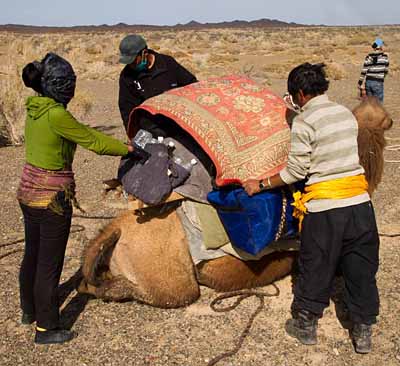
After Solongo’s Fall From Her Camel we rode until the sun went down and then camped for the night. The next morning we were up before dawn, since we still had two long days of riding to reach our destination south of Atas Bogd Uul.  Camp Boss Sister Dulya supervising the loading of a camel   Camp Boss Sister Dulya signs off on a perfectly loaded camel  Sister Dulya ready to ride Riding into black shale hills  Typical black shale hills of the Gobi  After passing through the black shale hills we emerged on a huge gravel flat. This is the view looking west.   Crossing the gravel flat. You can’t tell it from this photo, but the wind was blowing a relentless  sixty miles an hour.   Looking south across the grave flats toward Atas Bogd Uul, just visible in the distance.   Atas Bogd Uul from the southern edge of the gravel flats. In the foreground is a range of hills topped by 4,705-foot Arslan Khairkhan Uul, so named because th...

Uzbekistan | Khorezm | Khiva | Kunya Ark and Summer Mosque

Image
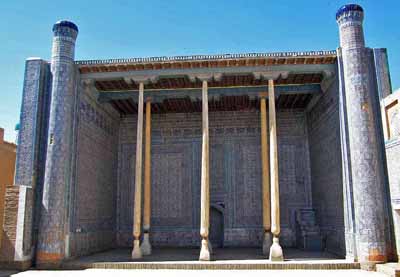
After visiting the Harem of Allah Kuli Khan I wandered by the Summer Mosque of the Kunya Ark, or Citadel. Finished in 1838, the mosque features spectacular tilework by local masters Ibadullah and Adullah Jin, who had also worked on Allah Kuli Khan’s harem.  Summer Mosque Pillars in the Summer Mosque Base of pillar in the Summer Mosque Pillars and Tilework  Tilework Tilework Tilework Tilework Minbar, or pulpit, in the corner of the mosque  The Kunya Ark, or Citadel, from outside View of the Inner City from the top of the Citadel View the Inner City from the top of the Citadel View from the top of the Citadel, with the Kalta Minaret , top, left-center View from the top of the Citadel with Islam Hoja Minaret (1910), middle Heart-palpitatingly gorgeous local hand-woven carpet. I sat on it for an hour, soaking up the vibes, but in the end did not buy, since the next stop in my wanderings is  Bukhara , whose very name is synonymous with carpets.   Thi...