Posts

Mongolia | Second of the Nine Nines | Khorz Arkhi Khöldönö

Image
Update: By 8:30 am the temperature has dropped to 36º below O F. This is a drop of 15 degrees since 5:30 am, which hardly seems possible, but I have rechecked the weather reports and this seems to be the case. 36 below 0 F. is certainly cold enough to freeze twice-distilled arkhi, so it seems we are indeed experiencing  Khorz Arkhi Khöldönö. I mentioned earlier that the First of the Nine-Nines —the Nine-Nines being nine periods of nine days each, each period characterized by a certain type of winter weather—started on the day of the Winter Solstice , which occurred here in Mongolia on December 22. The Second of the Nine Nines begins today, December 31. Known as Khorz Arkhi Khöldönö, this is the time when twice-distilled homemade Mongolian arkhi (vodka) freezes. As you will recall, the first of the Nine-Nines was the time when regular, or once distilled, arkhi freezes. As this indicates, the second period should be colder than the first, since twice distilled arkhi obviously has a m...

USA | Manhattan | E. Gene Smith

Image
E. Gene Smith , world-famous collector of Tibetan texts and founder of the Manhattan-based Tibetan Resource Center , has transmigrated. I had been in contact with Mr. Smith several times over the years, most recently in connection with an Unusual Kalachakra Tantra Text I had stumbled across. He came to Ulaan Baatar occasionally and I was a bit surprised when he said he wanted to meet me, since I am really not that involved with the world of Tibetan Buddhism. He had seen my book about Zanabazar, the First Bogd Gegeen of Mongolia, however, and he was keen to talk about Zanabazar. We finally met for lunch at the Delhi Darbar Restaurant in the  Puma Imperial Hotel where he was staying. Although it was just he and I for lunch we ended up talking for four hours. Amazingly, he had actually met the Diluv Khutagt . It is not quite clear who, if anyone, will step into the seven-league boots of Mr. Smith. He might well have been sui generis  in the field of Tibetan stu...

Mongolia | Zaisan | Eclipse | Nine Nines—Nermel Arkhi Khöldönö

Image
Wandered up to the summit of Zaisan Tolgoi (Noblemen’s Hill) to watch the Moon rise in eclipse on the evening of the 21st. It was minus 8º F when I reached the top. Not surprisingly I was the only person there.   The Summit of Zaisan Tolgoi The War Memorial at the top of Zaisan Tolgoi The total phase of the eclipse ended at 4:53 pm, just four minutes before the official moon rise time of 4:57. When the moon finally  did  clear the mountains to the east at about 5:15 it was of normal color and roughly 50% occluded; in other words it resembled a regular half-moon. By 6:05 the shadow on the moon had disappeared completely and it looked like a regular Full Moon. As you know, each Full Moon has a name associated with it. See  North American Names for the Full Moons . The last Full Moon before the Winter Solstice, is known as the Cold Moon, Frost Moon, or Long Nights Moon in English. This is the Full Moon that occurred yesterday. I don’t know if Mongolian...

Mongolia | Zaisan Tolgoi | Winter Solstice

Image
The Winter Solstice occurs here in Ulaan Baatar at 7:38 AM on the morning of December 22 (a lso see the  2009 Winter Solstice  and   2008 Winter Solstice ) .  December 22 will of course be the shortest day of the year: here in Ulaan Baatar the sun will rise at 8:39 am and set at 5:02 pm for a day of 8 hours, 22 minutes, and 53 seconds. That’s two seconds less the day before and four seconds less than the day after, December 23.  The Winter Solstice occurs 6:38 PM on the evening of December 21 in the Eastern United States, on the same day as the Total Lunar Eclipse , which is extremely unusual: This eclipse is notable because it takes place just hours before the December solstice, which marks the beginning of northern winter and southern summer. The last Dec. 21 total lunar eclipse occurred in the year 1638. (Number-crunchers quibbled for a while over whether that one counted as a solstice eclipse, due to shifts between the Julian and Gregorian calendar...

Mongolia | Zaisan | Full Moon | Lunar Eclipse

Image
Unless you have spent the last couple of months indulging in some totally heedless Bacchanalia in a basement bar in Greenwich Village you no doubt know that there is a  Total Lunar Eclipse  scheduled for December 21, 2010. In the Western Hemisphere the eclipse will fall on the same day as the Winter Solstice; here in Mongolia it will occur the day before.  Phases of the Eclipse, with Total in the Middle. For a more detailed view see Lunar Eclipse Phases .  Some of the best views of the Lunar Eclipse will be from the east coast of the United States. In Mongolia the situation is complicated to say the least. Here is the schedule (all local Ulaanbaatar times):  Penumbral begins:  1:29 pm Partial eclipse begins:  2:33 pm Total eclipse begins:  3:41 pm Full Moon at 4:13 Greatest eclipse:  4:17 pm Total Eclipse ends: 4:53 pm Moon Rises at 4:57 Sun Sets at 5:01 Partial eclipse ends: 6:01 pm Penumbral ends: 7:05  pm As can be seen from this t...

Mongolia | Gov-Altai Aimag | Camel Trip | Tsenkher Gov | Solongo

Image
The second day we continued south through the Tsenkher Gov. There was no wind at all and quite warm. Indeed in the afternoon it got downright hot and soon even the flies came out and started bothering our camels. This was not at all what I was expecting. During Previous Camel Trips in the Gobi during the first two weeks of October I had experienced numerous days of frigid temperatures and ferocious winds. Now I began to worry that our goat meat might spoil in the heat. Brother Duit and Sukhee allowed that it had been an unusually warm autumn so far. Whether it had anything to do with Global Warming they did not know.  Continuing across the Tsenkher Gov At 6:30 in the evening we camped for the night, having covered 36.2 kilometers (22.5 miles) that day. The sky was clear when I turned in, but at about two in the morning I woke up and noticed that it had clouded over completely and not a single star was visible. Also the temperature was falling and the wind was rising. When I got...

Mongolia | Gov-Altai Aimag | Camel Trip | Edrin Gov to Tsenkher Gov

Image
The Gobi is the fifth-largest desert in the world, covering roughly 500,000 square miles (1,295,000 square kilometers). While most of the world might think of the Gobi Desert as a single entity, people within Mongolia recognize thirty-three different gobis, or gov , as they are called in Mongolian. These gov are relatively flat areas, covered with sand or gravel of varying sizes, most trending east-west, and separated from each other by ridges of shale, granite, basalt, and other up-thrusting rocks. On our trip south from Bayan Tooroi we will pass through four govs. Zakhyn Us, where we started, is in the Zakhui Zartyn Gov, a flat area between the main crest of the Gov-Altai Mountains and the Edrin Mountains to the south. Crossing the Edrin Mountains we passed into the Edrin Gov. Much of this is classic zag desert—gravel flats covering with miniature forests of zag (saxaul bushes =  Haloxylon ammodendron ) The barren gravel flats of the northern edge of the Edrin Gov with Eej ...

Mongolia | Gov-Altai Aimag | Camel Trip | Bayan Tooroi to Edrin Gov

Image
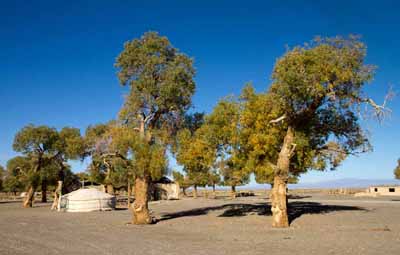
We arrived at the oasis of Bayan Tooroi at five in the afternoon and promptly checked into a ger at the headquarters of the Gobi A Protected Area Administration, which manages a huge chunk of the central Gobi, including the part we were heading into. Mishigdorj, the head of the Protected Area, issued us permits and informed us that Sukhee, the preserve ranger who had accompanied me on my last trip, was available and could also go on this trip. Apparently now you are not allowed to take extended trips into the Protected Area unless you are accompanied by a ranger. This was fine with me. I knew Sukhee was a knowledgeable and experienced camel guy. He also told us that at least one of our camel men would have to carry a gun, since there were reports of rabid wolves in the area we will be traveling through. Five people had just recently been attacked by rabid wolves, including two children playing in front of their gers in broad daylight.  Tooroi trees ( Populus euphratic a) which give...

Mongolia | Gov-Altai Aimag | Camel Trip | UB to Bayan Tooroi

Image
Around the end of September I was surprised by a call from my old friend Mojik , who I thought was in Switzerland. It turned out that she had returned to Ulaan Baatar two days before, and by coincident she had just gotten a call from a camel herder by the name of Tsogoo with whom she and I had done a Camel Trip Back in 2007 . Tsogoo was in town and wanted to meet. A real Gobi Desert Camel Guy who seldom comes to the big city of Ulaan Baatar, he seemed like a fish out water (if that metaphor is appropriate for a Gobi Guy) when we finally met up at the open air Uzbek beer garden on the west side of the State Department Store.   Tsogoo After some reminiscing about the 2007 camel ride, which featured a monumental Camel Stampede  and a Bizarre Encounter with a Rare Gobi Bear (there are only about thirty-five of them in the world), Tsogoo asked if I was ever going to do another camel trip in the Gobi. Indeed, there was one Gobi trip I still wanted to do. On the 2007 trip I ha...

Mongolia | Chingis Rides West | Xi Xia | Tanguts

Image
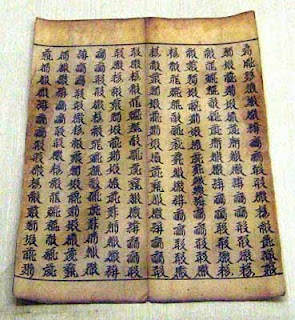
With the Uighurs Securely in His Corner Chingis was ready to launch a full-scale invasion of Xi Xia. The people of Xi Xia, known as Tanguts, founded the Xi Xia Dynasty, or “Great State of White and High,” in 1038. The Tanguts were a people of Tibeto-Burman extraction who had developed a prosperous agrarian and livestock breeding culture and occupied well-fortified towns and cities. They aspired to some level of culture and soon developed their own Writing System , based on Chinese ideograms, which they used to translate both Tibetan Buddhist texts and the Chinese Classics. While espousing Chinese culture they also practiced Tibetan-style Vajrayana Buddhism. They also maintained a large army and at their height were one of the strongest military powers in Inner Asia. Like the Uighurs they sat astride the Silk Road, controlling the vital Gansu Corridor, a narrow strip of land between the rugged mountains to the south and the inhospitable deserts to the north through which Silk Road cara...

Mongolia | China | Xinjiang | Chingis Rides West | Uighurs

Image
By the close of the year 1215 Temüjin, the Mongolian chieftain known to the world as Chingis Khan, was sitting pretty. Nine years earlier, in 1206, he had succeeded in defeating and bringing under his rule most if not all of the nomadic peoples of the Mongolian Plateau, and in a Great Assembly of the tribes on the Onon River he had been confirmed as Chingis Khan, the Great Khan of the Mongols. He then cast his gaze to the south, to the great sedentary civilizations of China which for over a thousand years had been the plundering grounds of the nomads to the north. As early as 1205 his forces had raided the borderlands of the kingdom of Xi Xia, centered around the modern-day Ningxia and Gansu provinces of China, and returned with huge hauls of camels and other livestock. In the autumn of 1207 an more ambitious raid raked in more plunder and even managed to capture the town of  of Wolohai, near current-day Tingyuan, in the Alashan region. Still not ready for a full-scale assault on X...