Posts

Mongolia | Gov-Altai Aimag | Camel Trip | Bayan Tooroi to Edrin Gov
Image
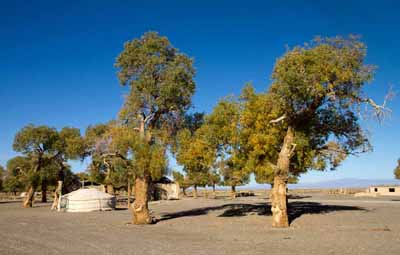
We arrived at the oasis of Bayan Tooroi at five in the afternoon and promptly checked into a ger at the headquarters of the Gobi A Protected Area Administration, which manages a huge chunk of the central Gobi, including the part we were heading into. Mishigdorj, the head of the Protected Area, issued us permits and informed us that Sukhee, the preserve ranger who had accompanied me on my last trip, was available and could also go on this trip. Apparently now you are not allowed to take extended trips into the Protected Area unless you are accompanied by a ranger. This was fine with me. I knew Sukhee was a knowledgeable and experienced camel guy. He also told us that at least one of our camel men would have to carry a gun, since there were reports of rabid wolves in the area we will be traveling through. Five people had just recently been attacked by rabid wolves, including two children playing in front of their gers in broad daylight.  Tooroi trees ( Populus euphratic a) which give...

Mongolia | Gov-Altai Aimag | Camel Trip | UB to Bayan Tooroi

Image
Around the end of September I was surprised by a call from my old friend Mojik , who I thought was in Switzerland. It turned out that she had returned to Ulaan Baatar two days before, and by coincident she had just gotten a call from a camel herder by the name of Tsogoo with whom she and I had done a Camel Trip Back in 2007 . Tsogoo was in town and wanted to meet. A real Gobi Desert Camel Guy who seldom comes to the big city of Ulaan Baatar, he seemed like a fish out water (if that metaphor is appropriate for a Gobi Guy) when we finally met up at the open air Uzbek beer garden on the west side of the State Department Store.   Tsogoo After some reminiscing about the 2007 camel ride, which featured a monumental Camel Stampede  and a Bizarre Encounter with a Rare Gobi Bear (there are only about thirty-five of them in the world), Tsogoo asked if I was ever going to do another camel trip in the Gobi. Indeed, there was one Gobi trip I still wanted to do. On the 2007 trip I ha...

Mongolia | Chingis Rides West | Xi Xia | Tanguts

Image
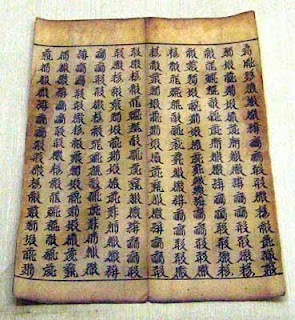
With the Uighurs Securely in His Corner Chingis was ready to launch a full-scale invasion of Xi Xia. The people of Xi Xia, known as Tanguts, founded the Xi Xia Dynasty, or “Great State of White and High,” in 1038. The Tanguts were a people of Tibeto-Burman extraction who had developed a prosperous agrarian and livestock breeding culture and occupied well-fortified towns and cities. They aspired to some level of culture and soon developed their own Writing System , based on Chinese ideograms, which they used to translate both Tibetan Buddhist texts and the Chinese Classics. While espousing Chinese culture they also practiced Tibetan-style Vajrayana Buddhism. They also maintained a large army and at their height were one of the strongest military powers in Inner Asia. Like the Uighurs they sat astride the Silk Road, controlling the vital Gansu Corridor, a narrow strip of land between the rugged mountains to the south and the inhospitable deserts to the north through which Silk Road cara...

Mongolia | China | Xinjiang | Chingis Rides West | Uighurs

Image
By the close of the year 1215 Temüjin, the Mongolian chieftain known to the world as Chingis Khan, was sitting pretty. Nine years earlier, in 1206, he had succeeded in defeating and bringing under his rule most if not all of the nomadic peoples of the Mongolian Plateau, and in a Great Assembly of the tribes on the Onon River he had been confirmed as Chingis Khan, the Great Khan of the Mongols. He then cast his gaze to the south, to the great sedentary civilizations of China which for over a thousand years had been the plundering grounds of the nomads to the north. As early as 1205 his forces had raided the borderlands of the kingdom of Xi Xia, centered around the modern-day Ningxia and Gansu provinces of China, and returned with huge hauls of camels and other livestock. In the autumn of 1207 an more ambitious raid raked in more plunder and even managed to capture the town of  of Wolohai, near current-day Tingyuan, in the Alashan region. Still not ready for a full-scale assault on X...

Mongolia | Zaisan Tolgoi | Autumn Equinox | Harvest Moon

Image
The Autumn Equinox Lady You are all probably busy making your plans for the celebration of the   Autumn Equinox , which occurs here in Mongolia on Thursday, the 23rd, at 11:09 AM. Here on the 23rd the sun comes up at 6:40 in the morning and sets at 6:49, making a day of twelve hours and nine minutes. Lately I have going each morning to the summit of Zaisan Tolgoi , near my hovel, to observe the sunrise and will undoubtedly be there on Thursday morning. I usually leave my hovel at 5:30, while most of you sluggards are still on bed, and arrive at the summit at about 6:00. Oddly enough, I am not alone at this hour. Three other people, two Mongolian men and a Mongolian woman, all looking to be in their sixties, also come to the summit each morning. The woman circumambulates the summit several times, stopping at each of the cardinal points to make prostrations. The men appear to be engaged in various and sundry meditations.  The summit of Zaisan Tolgoi Although I  intend to c...

Uzbekistan | Khoresm | Zoroastrians | Tower of Silence

Image
Zoroastrianism , founded in Persia in perhaps the 6th century BC by the mysterious character known as Zoroaster , a.k.a Zarathustra of “ Thus Spoke Zarathustra ” fame, is probably the world’s oldest “revealed” religion, and as such Zoroastrians are even regarded as “People of the Book”, along with Christians and Jews, by at least some Muslims (sorry, Buddhists remain garden-variety Idolators). The major premise of Zoroastrianism, as you no doubt know, is the vast cosmic struggle between   Ahura Mazdah ,   the God of Light (very roughly speaking), and  Ahriman ,   the principal of Darkness and Evil.  Zoroastrianism was very widespread in the Transoxiania and Khorezm regions before the arrival of the Islam in the eight and ninth centuries.  For an utterly titillating account of Zoroastrianism see In Search of Zarathustra . For still more see Magi .  Zoroastrian Burial Practices are of special interest. Bodies were placed on high hills or...